
Deep Knowledge
Leading vs Lagging Indicators
Why soil carbon, species counts and carbon flux cannot tell you if your land is improving, and how four leading indicators can. The diagnostic logic.
Abstract
If you manage land (a family farm, a 5,000-hectare estate, or a supply base for a food brand) you have almost certainly run into a question that is hard to answer well: is the land actually getting better?
Soil carbon is the usual place people look for the answer. But soil carbon is slow. It shifts on the timescale of years and decades, and by the time the lab result comes back, the seasons have moved on, the weather has intervened, and the window to course-correct has closed. The question is a good one; the instrument is the wrong one.
This piece is about a different way of seeing. It uses two categories. Lagging indicators are the traces life leaves behind: soil carbon, water infiltration rate, accumulated biodiversity. They shift slowly and tell you mostly about the past. Leading indicators are the working parts of the ecosystem that can be read directly, right now: live green canopy, bare soil, litter decomposition, functional plant groups, dung breakdown, and the many signs an experienced walker reads without thinking about them. Leading indicators respond to management in weeks and seasons. They are in front of you, if you know what to look for.
These same leading indicators can now also be read at scale from orbit, weather-corrected and continuously. What the eye sees on the ground, the satellite sees from space: the same signals at two scales that work together. A single framework, four ecosystem processes (solar flow, water cycle, mineral cycle, community dynamics) and the fifteen leading indicators that speak to them, organises both kinds of seeing.
Along the way, the piece explains why raw satellite-measured greenness swings by roughly fifty points a year from weather alone, and why, without correcting for that, most land-health claims built on satellite data are mostly measuring rainfall. It describes how climate effects can be separated from management effects, a method family known in the remote-sensing literature as RESTREND, which EcoIntel has adapted with its own implementation using public Copernicus satellite data and ECMWF climate data. And it shows how a pixel-to-field-to-site framework turns all of this into decisions a land manager, estate director, food brand, or nature-investor can actually act on.
It closes on what this makes possible: not just better measurement, but better management, and a land steward who can finally see the land clearly, and manage it from that clearer view.
The Question Everyone Is Asking Wrong
You measured the soil carbon. The number moved a little. So… is the land getting better?
This is the question every land manager, estate director, food brand, and nature-investor is asking in 2026. It is the question behind every regenerative claim, every carbon market, every Scope 3 disclosure, every quietly worried evening walk around the home farm. And the honest answer is: soil carbon alone cannot tell you.
Not because soil carbon doesn’t matter. It does, profoundly. But because soil carbon is what life leaves behind after years of doing its work. By the time the number moves, the decisions that moved it were made a long time ago, and the weather that shaped the interval is already baked in. If you want to know whether your land is getting better now, you need different instruments.
This piece is about those instruments. It is about the difference between the traces that life leaves behind and the force of life itself, and about how we can learn to see both: on the ground, and from orbit.
Chasing the Comet’s Tail
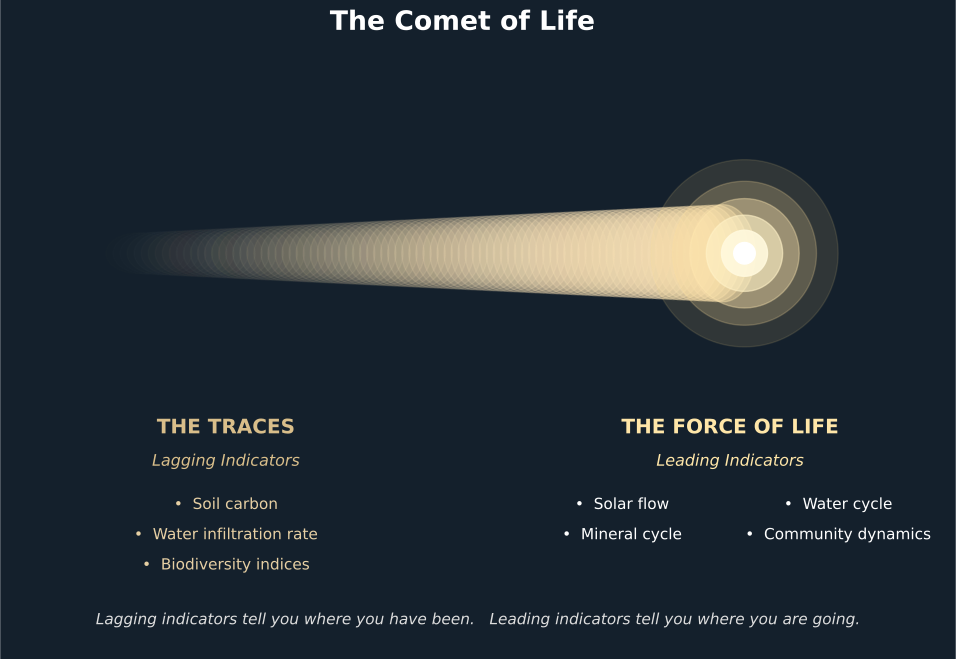
Wherever life exists on Earth (on land, in water, under the soil) it weaves itself out of sunlight, water, minerals, and the dynamics of the community of organisms that happen to share a place. Each weave has its own depth and complexity. The presence of certain marker species tells us about biodiversity. The stable carbon deposits in soils tell us about decades of photosynthetic work. The rate at which water infiltrates tells us about soil structure, aggregate stability, microbial activity.
All of these are real. All of them matter. But notice what they have in common: they are traces. They are the debris of life’s passage. They are what gets left behind after life has already happened.
This is the comet’s tail. Lagging indicators: slow-moving, accumulated, hard to shift, and crucially, telling us mostly about the past.
Soil carbon takes years to accumulate and years to release. Water infiltration changes on the timescale of soil structure. Biodiversity indices respond to management over seasons and decades. These are real measures of ecological wealth, but they are the wake of the boat. They can tell you where you have been. They struggle to tell you where you are going.
Up Close to the Pattern of Life
There is another group of indicators, and this is where the work of measurement gets interesting. These indicators are called leading indicators, and they get us close to the spearhead of life, to the moment where sunlight, water, minerals, and community dynamics blend to create the pattern that is life.
Leading indicators tell us about the generative flow of sunlight into a landscape, not the amount of radiation falling on it, but how much of it is being captured and made into life. They tell us about the effectiveness of rainfall where it falls, not the total millimetres, but how much of it stays and does work. They tell us about the capacity of the ecosystem to cycle minerals. They tell us about the maturity of community dynamics between species.
Leading indicators, in other words, tell us about the force that is putting carbon in the ground, not about the carbon itself.
The distinction matters because the force responds to management on the timescale of weeks and seasons. The trace responds on the timescale of years and decades. If you want to know whether your decisions are working (this week, this season, this year) you need leading indicators.
The Four Ecosystem Processes
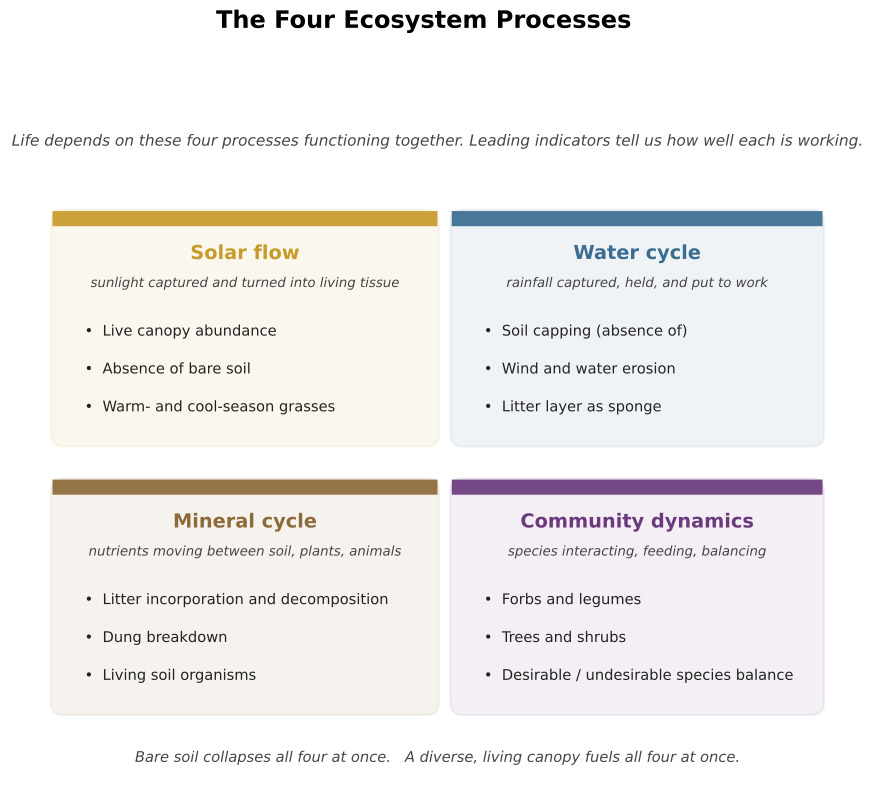
Leading indicators are anchored in a simple frame: four processes that together make life possible on any piece of land, in any ecoregion, on any continent.
- Solar flow: how effectively sunlight is being converted into living tissue. Green leaves are photosynthesis engines. Bare soil is a missed opportunity.
- The water cycle: how effectively rainfall is being captured, held, and used. Infiltration, retention, evapotranspiration balance.
- The mineral cycle: how effectively nutrients move between soil, plants, animals, and decomposers. Litter decomposition, dung breakdown, nutrient return.
- Community dynamics: how effectively species interact, feed, follow, compete, and balance. Plant functional groups, insect guilds, soil fauna.
When all four are functioning well, the land is productive, resilient, and building wealth. When one or more falter, the land drifts toward degradation, even if today’s yield looks fine. The four processes are the engine room of ecosystem health, and leading indicators are the instruments on the dashboard.
What You Can See on the Ground
Here is the remarkable thing about leading indicators: once you know what to look for, most of them are visible to anyone walking across a field. They are in front of you. You just need to learn to see them.
Start at your feet. Bare soil is the single largest sign of poor ecosystem health: no plants, no photosynthesis, no water capture, no root structure, no habitat for soil life. Ask: is the soil covered? By living plants? By a layer of decomposed plant matter? Scratch the surface: is it hard and capped, or soft and porous? A hard crust tells you water is running off, not in. A soft crumble tells you the opposite.
Look for signs of erosion. Wind erosion leaves soil dunes behind vegetation and on the leeward side of fenceposts. Water erosion leaves rills, gullies, exposed roots, and distinct colour changes in the vegetation along flow lines. Litter accumulates along flow paths; gravel gets exposed where soil has washed away.
Look at the plant litter itself. Is there a protective layer distributed across the ground? Is it decomposing: crumbly, moist, in contact with the soil? Or is it sparse, floating, matted, undecomposed? Active decomposition is a sign of a functioning mineral cycle. Mummified litter is a sign that the cycle has slowed or stalled.
Look for dung pats, if you run livestock. Old and new together, breaking down within a season, integrated into the soil: that is a functioning mineral cycle with active decomposers. Dung that simply sits on the surface, dry and crusted, is a broken cycle.
Scan for the density of living green plants, especially perennials. Healthy grassland fills its vertical space with photosynthetic tissue: leaves intercepting sunlight, roots stabilising soil. Patchy cover with dominant annuals and bare patches tells a different story.
Look for plant functional groups: the mix of warm-season (C4) grasses, cool-season (C3) grasses, forbs, legumes, shrubs, trees. Diversity across functional groups builds resilience: different rooting depths, different seasonal niches, different contributions to the nutrient cycle. A monoculture of ryegrass does not.
Kneel down and look at the microfauna. Dung beetles, ants, earthworms, insect holes, spider webs, butterflies. Can you find pollinators, predators, parasitoids, decomposers, herbivores? Functional richness in insect life parallels richness in plant structure. A landscape in which it is hard to find insects is a landscape whose community dynamics have thinned.
These are the signals that are in front of you. Fifteen of them, taken together, compose a strong ecological diagnosis anchored in peer-reviewed ecological literature (see Xu et al. 2019):
Live Canopy Abundance · Living Organisms · Warm-Season Grasses · Cool-Season Grasses · Forbs and Legumes · Desirable Trees and Shrubs · Contextually Desirable Rare Species · Contextually Undesirable Species · Litter Abundance · Litter Incorporation · Dung Decomposition · Bare Soil · Soil Capping · Wind Erosion · Water Erosion
Each maps to one or more of the four ecosystem processes. Bare soil collapses all four at once. Litter and dung decomposition speak to the mineral cycle. Functional plant groups and species balance speak to community dynamics. Live canopy abundance speaks to solar flow. Soil capping and erosion speak to the water cycle.
This way of seeing is ecoliteracy. It is the single most empowering capacity for anyone whose work is the land, because it turns a walk around the farm from an inspection into a diagnosis.
The Limits of Walking Your Land
And yet. Ecoliteracy on the ground runs into limits, quickly, as soon as the question gets bigger than what you can walk in a week.
Scale. A 5,000-hectare estate cannot be walked in depth every fortnight. A food brand sourcing from 500 farms cannot send observers to each, repeatedly, forever. A nature-investor with holdings across three continents cannot build a ground-truth programme that keeps pace with the land.
Weather. Your eye cannot subtract weather from what it sees. A pasture that looks poor in a drought year might be in excellent management. A pasture that looks lush in a wet year might be masking serious decline. Without a way to separate the management signal from the weather noise, ground observation alone is noisy.
Time. Trends emerge over multiple seasons. What you see today tells you about today, not about the trajectory. Holding the memory of what the same field looked like at the same time last year, and the year before, exceeds normal human recall.
Observer drift. Two skilled assessors will disagree on the edge cases. The same assessor, six months apart, will disagree with themselves. Calibration is possible but expensive.
Comparison. Ground observation is anchored in place. Comparing your land to a thousand peers is not something a boot-and-clipboard method delivers.
These are not arguments against ecoliteracy. Ecoliteracy is the foundation. They are arguments that ecoliteracy on its own is not sufficient for the questions of 2026. For that, we need a second set of senses.
From Eye to Orbit
The satellite is that second set of senses. Every five days, the European Space Agency’s Copernicus Sentinel-2 mission images your land at 10-metre resolution across thirteen spectral bands using its Multispectral Instrument (MSI; Drusch et al. 2012). Every six days, Sentinel-1’s C-band Synthetic Aperture Radar (SAR; Torres et al. 2012) sees through cloud cover in VV and VH polarisations, indispensable for cloudy climates. Landsat and MODIS add historical depth and specialised products for fire and coarse-scale context. The raw data from the Copernicus programme is free, public, and continuous. The problem has never been access. The problem has always been interpretation.
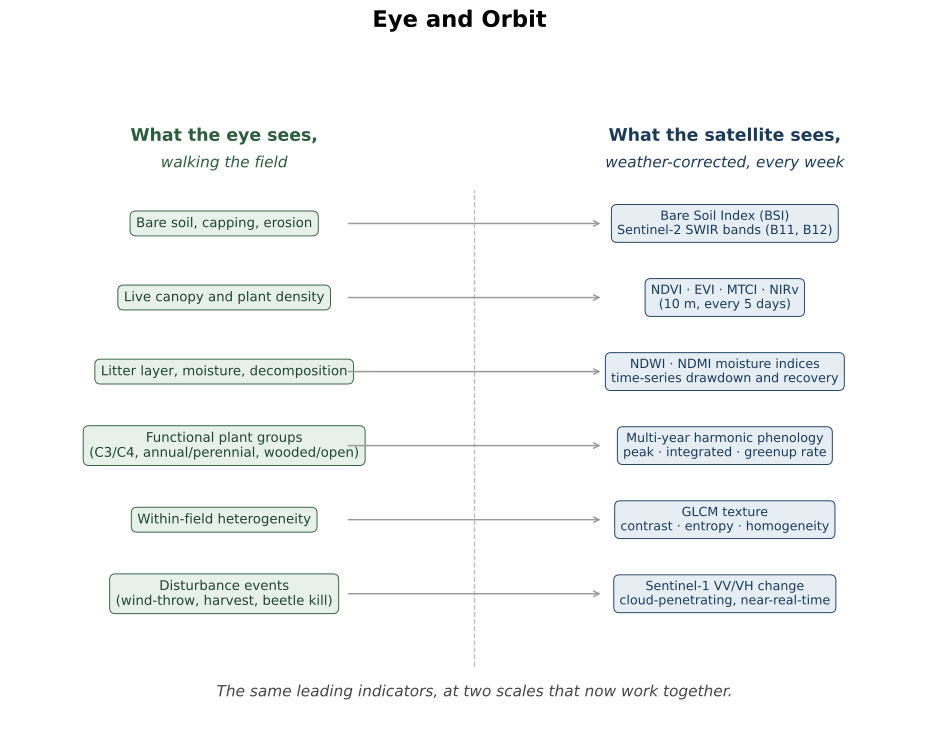
Because here is what matters: the satellite, properly read, sees the same leading indicators that the skilled walker sees. Not by magic, but by a mature and published literature of spectral indices, each grounded in the physics of how light and microwaves interact with leaves, stems, soil, and water.
- Live canopy abundance → captured by the Normalised Difference Vegetation Index (NDVI; Tucker 1979), the Enhanced Vegetation Index (EVI; Huete et al. 2002), the MERIS Terrestrial Chlorophyll Index (MTCI; Dash & Curran 2004), and NIRv (Badgley et al. 2017). NIRv, the product of near-infrared reflectance and NDVI, is a physiologically grounded proxy for Gross Primary Productivity, usable at 10 m per field rather than at the coarse resolution of space-borne solar-induced fluorescence. MTCI is computed from Sentinel-2’s red-edge bands (B5, B6, B7) and gives a direct chlorophyll signal where NDVI saturates.
- Bare soil and ground cover → the Bare Soil Index (BSI) separates bare from vegetated surfaces using the shortwave-infrared bands designed for the purpose; Sentinel-2 MSI bands 11 (1610 nm) and 12 (2190 nm) are the workhorses. Fractional green-cover proxies derived from NDVI thresholds provide a second line of evidence.
- Functional plant groups → rather than detecting classical phenology events from threshold-crossing rules, which are noisy and sensitive to cloud gaps, a multi-year harmonic regression (sine/cosine decomposition) is fitted to the NDVI time series, and smoothed features extracted: peak greenness, time-integrated greenness, greenup rate, peak week, and growing-season mean. The harmonic approach is robust to missing observations, cross-year comparable, and produces a phenological signature that distinguishes C3 from C4 grasslands, perennial from annual cover, and wooded from open land.
- Water cycle function → the Normalised Difference Water Index (NDWI; Gao 1996) and the Normalised Difference Moisture Index (NDMI) track surface moisture, greenness drawdown during dry spells, and vegetation recovery after rain across the time series.
- Community dynamics and complexity → spatial texture metrics derived from the Grey-Level Co-occurrence Matrix (GLCM; Haralick et al. 1973), namely contrast, entropy, homogeneity, angular second moment, capture within-field heterogeneity that correlates with functional diversity on the ground.
Alongside this leading-indicator palette, Sentinel-1’s radar plays a different role: detecting disturbance. Where the optical indices build a picture of slow-moving ecosystem state, radar backscatter, in particular year-on-year change in VH polarisation, flags sudden events: partial harvest, wind-throw, bark-beetle kill, illegal clearance. Because radar sees through cloud, the signal is available even during weeks when Sentinel-2 cannot. This complements the health-scoring pipeline with an event-detection layer that does not depend on clear skies.
What the eye sees in one field in one hour, the satellite sees across every field you manage, every week, forever. But there is a catch, and it is a big one.
The Weather Halo
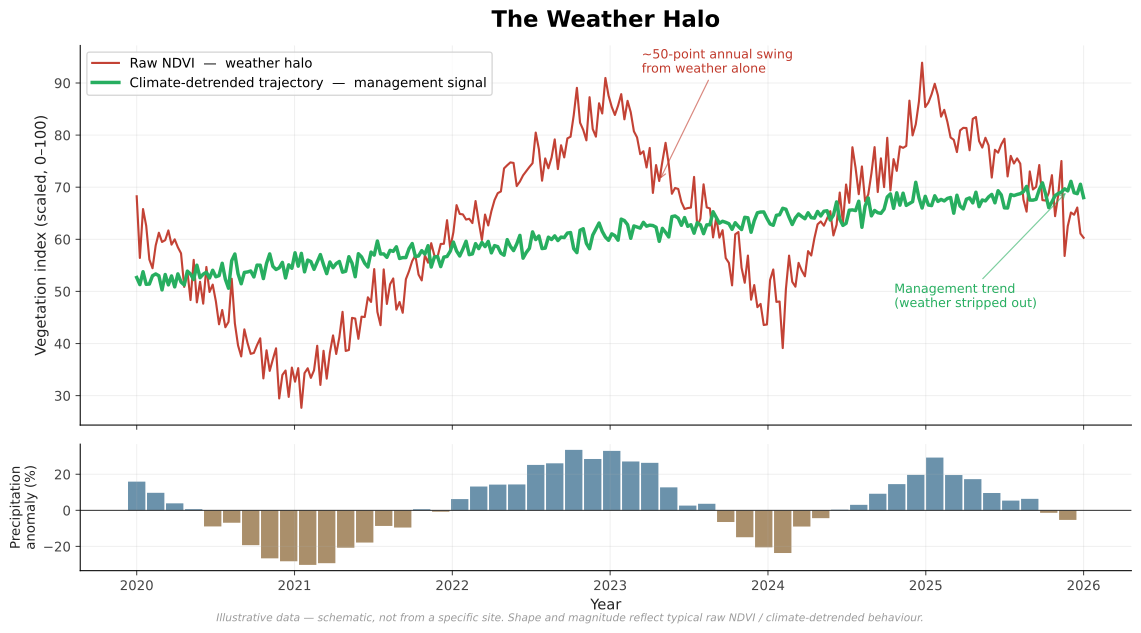
Raw satellite greenness moves by roughly fifty points per year on any given piece of land, independent of management.
That sentence deserves to sit on its own. It is the single most important thing to know about remote-sensed indicators, and almost nobody outside the remote-sensing community says it out loud.
Think about what it means. A land manager who makes no changes at all will see their NDVI swing by fifty points between a wet year and a dry year. A land manager who makes excellent changes in a dry year will see their NDVI apparently fall, because the weather pulled it down faster than their management pulled it up. A land manager who does nothing in a wet year will see their NDVI rise and pat themselves on the back for a grazing plan that did nothing.
If you judge your land on raw greenness, weather will fool you, in both directions, every year. Entire policy debates about whether “regenerative” methods “work” have been conducted on data that is mostly recording whether it rained.
The fix is not to abandon the satellite. The fix is to separate the two signals: the signal of management from the noise of weather. The leading example of this work in the remote-sensing literature is Residual Trend analysis, or RESTREND, introduced by Evans and Geerken (2004) in the context of dryland degradation monitoring and extended by Burrell, Evans, and Liu (2017) as Time Series Segmentation RESTREND (TSS-RESTREND), with Wessels, van den Bergh, and Scholes (2012) setting out its limits. RESTREND regresses a vegetation index against the climate covariates that drive it and reports the residual, the fraction of greenness that weather alone cannot account for, as the management signal.
In the same tradition, EcoIntel has built its own equivalent model from the data at its disposal. Drawing on the multi-year spectral time series from Sentinel-2 and daily climate data from ERA5-Land (Muñoz-Sabater et al. 2021), with stress-week counts derived from zone-specific temperature and precipitation optima, vapour pressure deficit, and the ratio of actual to potential evapotranspiration, EcoIntel’s eco-dynamic diagnostic framework integrates climate directly into the prediction model rather than residualising after the fact. The end result is the same as RESTREND’s: the weather signal is separated from the management signal, leaving a climate-detrended trajectory that reflects decisions, not rainfall. The approach is transparent, reproducible from public Copernicus and ECMWF data, and independently verifiable by any third party willing to redo the analysis from scratch.
The consequence is dramatic. On sites where raw NDVI swings fifty points a year, the climate-detrended trajectory typically moves by a handful of points around a clear management signal. The weather stripped out. The signal of decisions left in. A leading indicator, at satellite scale, that can actually tell you whether the plan is working, and one that is defensible to an auditor, a journalist, or a competing scientist.
From Pixel to Field to Site
A single pixel is a signal. A field is a decision unit. A site is a portfolio. Leading indicators need to operate at all three scales, and each scale needs a statistically principled way to roll up the one below it.
At the pixel level (10 m × 10 m for Sentinel-2 MSI, 20 m for Sentinel-1 SAR, 30 m for Landsat) the eco-dynamic diagnostic framework delivers a multi-year time series of spectral indices, climate-detrended greenness, moisture, texture, and phenological features. Every ten metres, every five to six days, indefinitely. The pixel is the atomic unit of evidence.
At the field level, pixels aggregate with contextual weighting. Each pixel is classified against a land-cover baseline: Dynamic World V1 (Brown et al. 2022), a near-real-time 10 m product derived from Sentinel-2. This means arable, grassland, wooded land, and bare rock contribute differently to the field-level summary. Aggregation is area-weighted: a 12-hectare field is summarised not by the arithmetic mean of its pixels but by a weighted synthesis that respects what kind of land each pixel actually is.
At the site level, fields aggregate into a portfolio view, area-weighted across the full land holding, so that a thousand-hectare block of grassland carries its due weight relative to a five-hectare wood, and so that changes at one scale are never confused with changes at another. Uncertainty propagates upward: the confidence in each pixel’s estimates contributes to the confidence interval around the field-level number, which in turn bounds the site-level trajectory. Every reported number comes with a statistical range. Every range can be traced back to the underlying pixel time series. The provenance runs all the way down.
The Questions Everyone Is Asking, Answered with Leading Indicators
Return to the questions that opened this piece.
Is the land getting better? Ask whether the climate-detrended greenness is trending upward, field by field. Ask whether bare soil fraction is shrinking. Ask whether the phenological signature is strengthening: earlier greenup, higher peak greenness, a longer and fuller growing season, stronger red-edge chlorophyll signal through to senescence. Ask whether functional plant group signatures are diversifying in the phenology and texture bands. These are current, weekly, and weather-clean: the leading indicators of ecosystem function.
Is my grazing plan working? Same questions, framed at the field level, compared against baselines set before the plan began. The weather-correction is crucial here, because grazing plans are almost always judged against weather-confounded data and unfairly credited or blamed for changes that had nothing to do with the plan.
Is my buyer’s regenerative claim real? The claim lives or dies on leading indicators. Soil carbon lags, will not move fast enough to verify a 2030 target, and is confounded by baseline variability. Leading indicators (phenology signatures, bare soil fraction, climate-detrended greenness trend) move within 12–24 months and can be independently verified from public satellite data by any third party willing to apply the published methods.
Where should I invest management effort? Leading indicators reveal the fields that are drifting, not just the fields that are visibly poor. The gap between where a field is and where a similar field is performing in the same ecoregion is itself a leading indicator, a leading-indicator gap, pointing directly at the highest-leverage management investment.
What is happening under my grass that I can’t see from the ground? This is the question the satellite answers best. The places you cannot get to (the remote hill pasture, the neighbour’s herd-impact, the edges where field meets woodland) are all in the imagery, every week, waiting to be read. Disturbance events, too: the sudden change that would take you weeks to notice on foot shows up in the radar within days.
Seeing Differently
Leading indicators make something possible that lagging indicators cannot: a view of the current state of the land that is current, weather-clean, and scalable from a single field to a continental portfolio. They turn a question that used to take years to answer (is the land actually getting better?) into one that can be answered this season, in time to adjust the plan.
The contribution of the eco-dynamic diagnostic framework is not certainty, but sight. Not replacement of the experienced walker, but augmentation with a second set of eyes that sees what the walker alone cannot: every field, every week, weather-corrected, continuously. From there, the decisions get better. The grazing plan is judged against what management actually did, not what the weather added or subtracted. The drifting field is spotted before it becomes a visibly poor one. The claim of regeneration is backed by measurements a third party can verify. The question of where to invest the next effort is answered not by intuition alone but by a leading-indicator gap that points to where the leverage is greatest.
With this kind of framework, and this kind of ability to see differently, real difference becomes possible.
This is what EcoIntel makes available at ecointel.io, an online platform that handles the full workflow: assessment of the current ecosystem state, diagnostic of which processes are functioning and which are struggling, and reporting that brings both together with management-action insights. The platform runs continuously on the public Copernicus data stream and the analytical framework described in this piece, so that any land manager, estate director, food brand, or nature-investor can work from weekly, field-level, leading-indicator intelligence without having to build the pipeline themselves.
Soil carbon is not wrong. It is just not enough. It is the trace, and by itself it will not tell you whether your land is getting better in time to do anything about it. For that, you need the comet’s head. You need the leading indicators. You need the eye that walks the field, and the satellite that watches it, weather-corrected, between your visits.
That is what ecoliteracy looks like in 2026.
References
Ecological diagnostic framework
- Xu, S. et al. (2019). Ecological Health Index: A Short Term Monitoring Method for Land Managers to Assess Grazing Lands Ecological Health. Environments, 6(6), 67.
Vegetation indices and remote-sensing foundations
- Tucker, C. J. (1979). Red and photographic infrared linear combinations for monitoring vegetation. Remote Sensing of Environment, 8(2), 127–150. (NDVI origin.)
- Huete, A., Didan, K., Miura, T., Rodriguez, E. P., Gao, X., & Ferreira, L. G. (2002). Overview of the radiometric and biophysical performance of the MODIS vegetation indices. Remote Sensing of Environment, 83(1–2), 195–213. (EVI.)
- Dash, J., & Curran, P. J. (2004). The MERIS Terrestrial Chlorophyll Index. International Journal of Remote Sensing, 25(23), 5403–5413. (MTCI origin.)
- Gao, B.-C. (1996). NDWI — A normalized difference water index for remote sensing of vegetation liquid water from space. Remote Sensing of Environment, 58(3), 257–266.
- Badgley, G., Field, C. B., & Berry, J. A. (2017). Canopy near-infrared reflectance and terrestrial photosynthesis. Science Advances, 3(3), e1602244. (NIRv origin.)
- Haralick, R. M., Shanmugam, K., & Dinstein, I. (1973). Textural features for image classification. IEEE Transactions on Systems, Man, and Cybernetics, SMC-3(6), 610–621. (GLCM texture.)
Climate normalisation / residual-trend methodology (RESTREND lineage)
- Evans, J., & Geerken, R. (2004). Discrimination between climate and human-induced dryland degradation. Journal of Arid Environments, 57(4), 535–554. (RESTREND origin.)
- Wessels, K. J., van den Bergh, F., & Scholes, R. J. (2012). Limits to detectability of land degradation by trend analysis of vegetation index data. Remote Sensing of Environment, 125, 10–22.
- Burrell, A. L., Evans, J. P., & Liu, Y. (2017). Detecting dryland degradation using Time Series Segmentation and Residual Trend analysis (TSS-RESTREND). Remote Sensing of Environment, 197, 43–57.
Climate reanalysis data
- Muñoz-Sabater, J. et al. (2021). ERA5-Land: a state-of-the-art global reanalysis dataset for land applications. Earth System Science Data, 13(9), 4349–4383.
Land cover
- Brown, C. F. et al. (2022). Dynamic World, Near real-time global 10 m land use land cover mapping. Scientific Data, 9, 251.
Satellite missions
- Drusch, M. et al. (2012). Sentinel-2: ESA’s optical high-resolution mission for GMES operational services. Remote Sensing of Environment, 120, 25–36.
- Torres, R. et al. (2012). GMES Sentinel-1 mission. Remote Sensing of Environment, 120, 9–24.
- Copernicus Sentinel Programme technical documentation, European Space Agency (ongoing).
Nutrient density (context for related pillars)
- van Vliet, S. et al. (2024). Preliminary results of the Beef Nutrient Density Study (peer-reviewed publication forthcoming).
Related glossary entries
- Comet of Life: the metaphor distinguishing leading from lagging indicators
- Weather Halo: the ~50-point annual swing in raw greenness driven by weather, not management
- Eye and Orbit: the same leading indicators seen at two scales, on the ground and from orbit
- Leading-Indicator Gap: the delay between when function changes and when lagging measures detect it
- Weather-corrected Scoring: separating the management signal from weather noise
- Land Health Score: the 1–9 condition scale these indicators feed
Frequently asked
What's the difference between leading and lagging indicators of land health?
Lagging indicators like soil-carbon stock only confirm change years after it happens. Leading indicators (climate-detrended greenness trend, bare-soil fraction, phenology and red-edge chlorophyll signals) move within 12–24 months, revealing whether land is improving in time to act. EcoIntel reads them weekly, weather-corrected, from public satellite data.
Is soil carbon enough to prove regeneration is working?
No. Soil carbon isn't wrong, it's just not enough. It lags, won't move fast enough to verify a 2030 target, and is confounded by baseline variability. A regenerative claim lives or dies on leading indicators, which move within 12–24 months and can be independently verified from public satellite data.
Is EcoIntel's satellite-derived carbon the same as a verified carbon credit?
No. EcoIntel is an ADP (Assessment, Diagnostics, Practical guidance), the diagnostic layer beneath MRV. It does not issue verified carbon credits and is not an MRV platform; its carbon figures are diagnostic, for internal corroboration, complementing an MRV pipeline rather than replacing it.
How fast can leading indicators show whether a grazing or management plan is working?
Within 12–24 months. Judged against baselines set before the plan began, and weather-corrected so the plan is credited or blamed for what management actually did, not what the weather added or subtracted.