
For farmers and land managers
Know what your land is actually doing
Field-by-field health, trajectory, and the most direct next step on your specific land.
See every map layer of your farm in one place →
Watch our quick intro videoFarming in the EU or the UK?
The schemes, and the reasons your buyers ask, are different in each. Start where your land is:
The questions EcoIntel was built to answer
- Is my land improving or going backwards?
- What is dragging this field down?
- Where should I act first?
- What does better look like, and how do I get there?
What you get
A single ecological performance score
The Land Health Score is a nine-level scale per field, scored at weekly resolution. You see where every parcel stands and whether it is improving, holding steady, or going backwards.
Field-level analysis you can act on
Within-field 10 m hexagon resolution. See where the wet corner is, where bare patches are opening, where the trajectory diverges from the rest of the parcel.
Decision support, not just data
Quick-wins block, strategic-investments block, per-field opportunity and risk cards. The system tells you what to do next and why.
Evidence for stakeholders
Documentation of ecological health for landlords, lenders, succession conversations, and your own records. Reports built around the question being asked.
How it works
- Upload your field boundaries. One map upload activates the whole farm, with no sensors and no manual data entry.
- Get a multi-year history. Every parcel arrives with continuous scores back to 2018.
- See the four processes. Energy, water, mineral and community indices show why the land is performing the way it is.
- Act with confidence. Opportunity and risk cards translate the diagnosis into next moves.
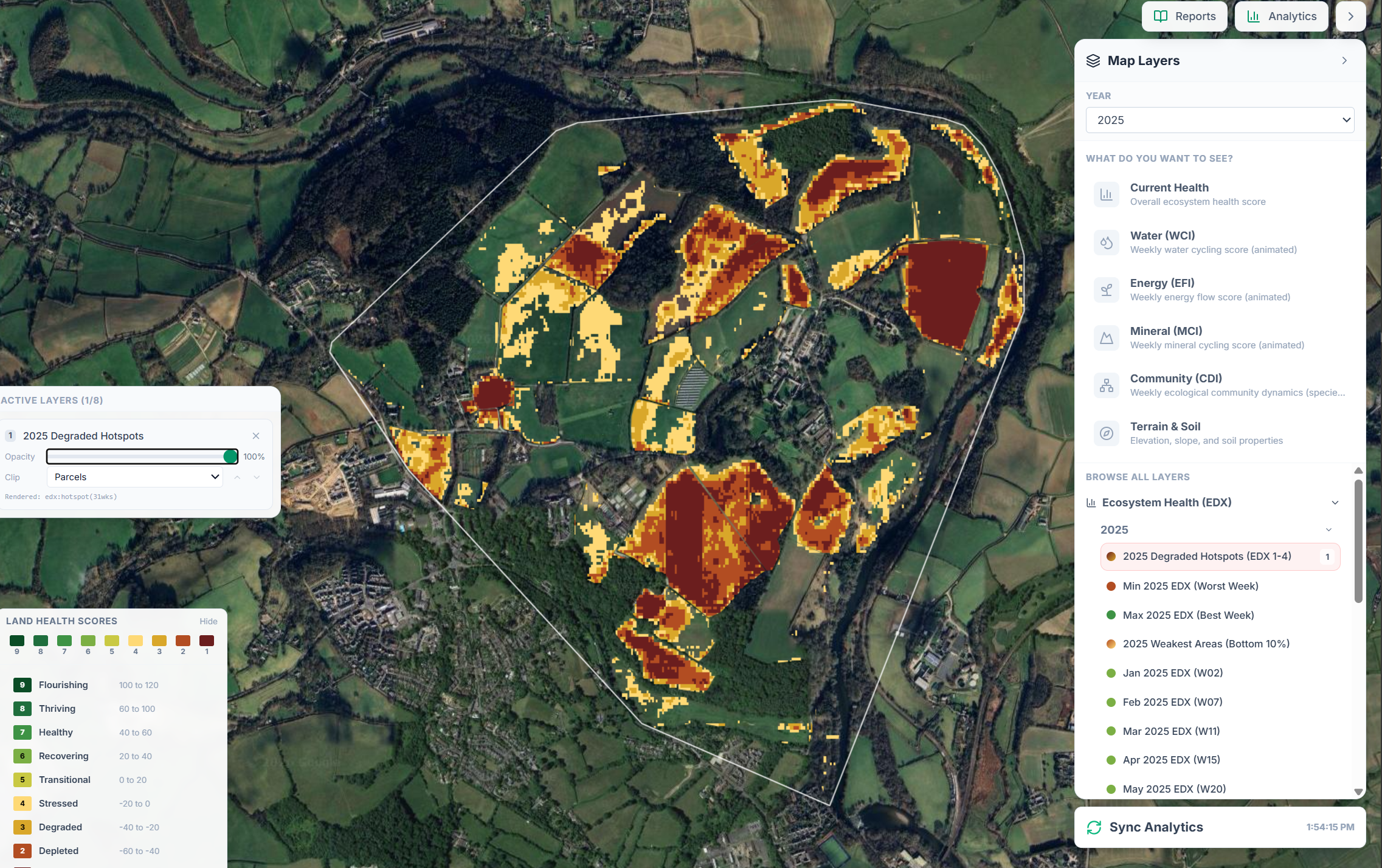
What you get back, field by field
EcoIntel reports are not abstract dashboards. They are per-field cards built around the question being asked:
Opportunity cards
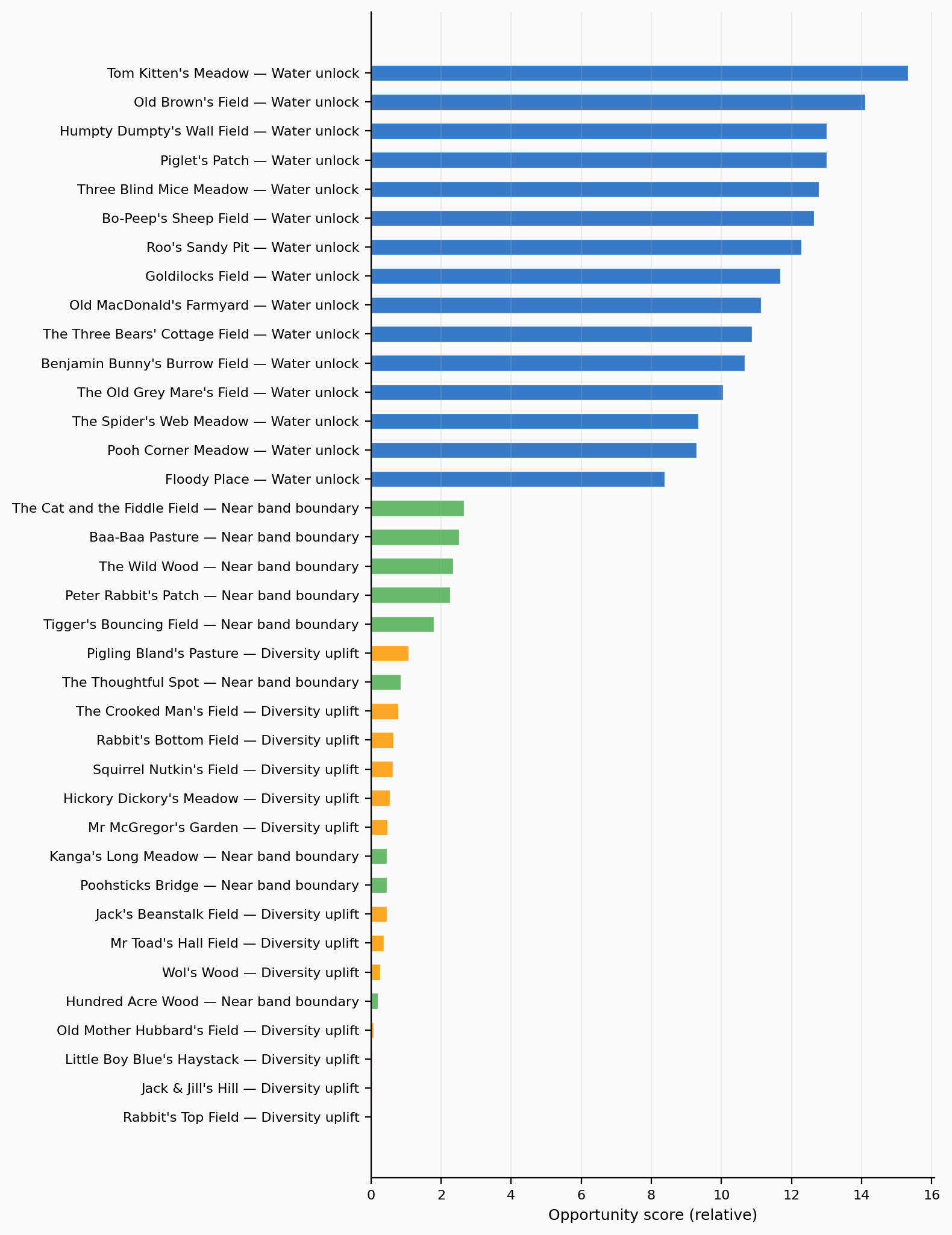
Specific opportunity, root cause, first move and timing. Answers "what should I do on this field?"
Risk cards
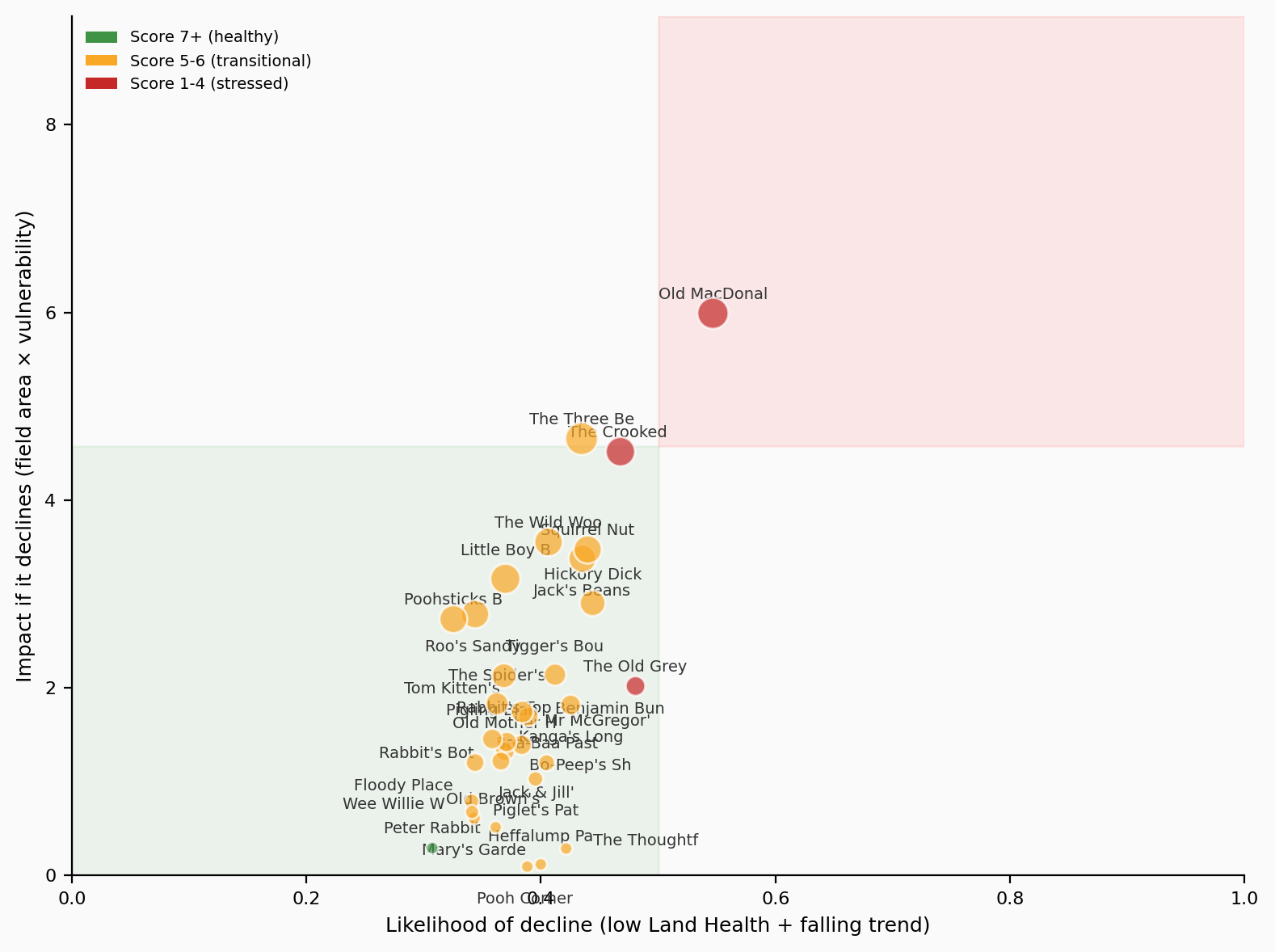
Per-field likelihood, impact, vulnerabilities and mitigation, across ecological and financial dimensions.
Seasonal-profile cards
Hillshade, topography, quarterly strength, plus a Management Assessment, Recommendations and Strategic Potential block per field.
Topology cards
Landscape position and enterprise suitability. Answers "what is this field for?"
Grazing rotation, rest & stocking
Field-specific advice on timing, rest length and stocking density: the diagnosis translated directly into a livestock-calendar action.
Environmental-zone card
Ties the field to its broader climate and ecoregion context: what's possible here, not what's possible elsewhere.
Above the per-field detail sits the Master Land Health Report (an eleven-section diagnostic for the whole property) and a standalone one-page Diagnostic Synthesis for when only the headlines are needed.
Risk and opportunity, mapped to your specific fields
Two of the most-used visualisations in every report. The Risk Matrix scores every field on likelihood × impact across ecological and financial dimensions; the Opportunities Map ranks every field on the size and ease of the next move available there.
Make your farm ESG-ready, at farmer prices
A new category is forming fast: every farm in the EU and UK is being pulled into ecologically literate, framework-aligned, defensible questions about its land, from buyers under CSRD scope, lenders writing nature-aligned credit, regulators implementing SDR, supply chains stitching together Scope 3, schemes paying for outcomes. Almost no tooling exists at farm scale to answer these questions with evidence. That's the ESG-readiness gap →
EcoIntel closes it at Founding-Member pricing. One map upload, one property, one annual subscription, and your farm becomes ESG-ready in the same shape a corporate sustainability team would expect. No bespoke engagement. No multi-six-figure project. Same scoring engine, same satellite history, same framework alignment.
What your farm gets, ESG-side
- A defensible Land Health Score: weather-corrected, ecoregion-calibrated, with a confidence label. The answer to "what is the ecological condition of this land, and how do you know?"
- An eight-year trajectory record, back to 2018, weather-detrended. The answer to "is it improving, holding, or declining?"
- A corroborated carbon balance, cross-checked against 14 authoritative public reference datasets with σ-band verdicts. The answer to "what is the carbon balance, and how would an auditor read it?"
- A 30-year forward carbon projection, with a permanence-risk label per parcel. The answer to "what is the projection, and how durable is it?"
- Per-field risk and opportunity: likelihood × impact across ecological and financial dimensions. The answer to "where is the downside, and where is the next move?"
- Framework-aligned reports: TNFD LEAP, CSRD/ESRS E4 & E1, GHG Protocol, ISO 14064-2. The same disclosure surfaces corporates use, ready to hand to a buyer, a lender, or a scheme.
What's available today, and what's coming. The framework-mapped data points listed above (TNFD-aligned, ESRS-aligned, GHG Protocol-aligned) are in your dashboard now on both Founding-Member tiers. The packaged ESG-readiness view that brings them together as a single disclosure-ready surface is in development; first release shipping early H2 2026. The dated, framework-mapped Evidence Pack you hand to a buyer, lender, scheme administrator or auditor ships in the same window, available to Annual subscribers only and refreshed annually to align with your disclosure window.
The contrast with Corporate ESG. Multi-site portfolios, bespoke scoping and dedicated account management live on the Corporate plan. Single-farm ESG-readiness, for the farmer, the estate owner, the family-business operator, lives on the Founding-Member plan. Same data shape. Different price.
Frequently asked
Do I need sensors or equipment?
No. One map upload activates the whole farm, with no sensors, no installation, no manual data entry. Scoring uses satellite, terrain and climate inputs only.
How far back does the history go?
Every parcel arrives with a continuous, weather-corrected scored history back to 2018, so you can see whether the land is improving, holding, or going backwards, across good weather years and bad.
Can a farm become ESG-ready with EcoIntel?
Yes, at farmer prices. The same framework-aligned data a corporate sustainability team would expect (TNFD, ESRS, GHG Protocol) is in your dashboard, so you can answer buyer, lender, regulator and scheme questions with evidence rather than a questionnaire.
What will it actually tell me to do?
Per-field opportunity and risk cards translate the four-process diagnosis into the next move (what to do on each field, the root cause, and the timing), plus grazing, rest and stocking guidance.
Want to try it free first?
Sign up to Wilder Wood Farm, Davonia and explore the Land Health System on our demonstration property, at no cost, before bringing your own land in.