
Research & Perspective
The “E” in Food Sector ESG: a 30-year journey from selective brand stories to ecosystem condition assessment and management
Over 30 years, the “E” in food-sector ESG has moved from selective brand stories to a harder demand: credible, complete evidence on the health of nature. That demand now resolves to one thing, ecosystem condition, which food companies are expected not only to disclose but to manage across the farms in their supply chains. This piece is written for those making corporate sustainability decisions.
Setting the context
Even though the political mood music has seemingly reversed in the era of Trump, the pressure on food and farming companies to assess, disclose and improve an increasingly comprehensive assessment of their ecological impact continues to grow.
The root cause of that pressure is that as human society at large, we know our efforts to reverse the trend of ecological collapse have largely been unsuccessful and despite counter-narratives in populist politics, people generally understand that we have to do better.
The water is muddied by the fact that for older generations there is still a culture and narrative that says we have to choose between feeding the world and saving the planet. Young people know we must do both.
This article is all about the Environmental agenda for the food sector. It has three parts. First, a summary of the key challenges that the food sector faces today in addressing its environmental impact. Then an analysis of how and why we got here. And finally an exploration of what to do next. It is written primarily for those involved in decision making in corporate sustainability.
It is analysis that is relevant to anyone interested in our collective ability to change the trajectory of ecosystem collapse and what feels like our current inexorable march into the 6th Extinction.
It is relevant because the food sector can be our greatest lever of positive change. The article looks through the lens of environmental reporting and disclosure and the opportunities (and of course threats) that are unfolding for every food company to really make a difference.
It revolves around a single powerful idea. That the task for us all is to focus on overall land health.
Four key challenges today
The four key issues that food sector companies now face in terms of their environmental impacts are interconnected. They represent a seismic challenge because the risks associated with failing to address them have never been greater.
- The focus is shifting to a more complete view
Advances in systems sciences are moving the assessment agenda from hanging everything on single metrics to a more comprehensive view. In the past a company could build an approach to the environment that was for example, all about achieving net zero in terms of direct carbon emissions. The central question now increasingly is “How healthy is nature?” The technical term is “ecosystem condition”.
- Greenwashing enforcement is rising.
For most of the past three decades, the danger was saying and doing too little. Now it is making partial claims that do not stand the test of completeness and/or accuracy. Credible, verifiable and independent systems-level environmental data is becoming critical. Reporting numbers generated by farmer questionnaires and generic assessments based on “similar land studied elsewhere” are not sufficient.
- The supply chain is your responsibility.
For the food sector, typically 80 to 95% of the environmental footprint of a company sits in its supply chain with the great majority of that on farms. This is the hardest part to measure and manage, both from a practical perspective and cost effectively.
- From disclosure to a duty to act.
The EU’s CSDDD is the signpost to the nature of compliance standards across the world. Even after being narrowed by the Omnibus, it now requires larger companies in the food and farming sector to not only identify environmental harm across their value chains, but also prevent and remediate it. In other words, it’s not good enough to just report the ecological impacts of nitrogen runoff or the use of chemicals on farms. The regulations require companies to pro-actively address the problems and deliver verifiable improvements in outcomes. And if they don’t, they will be held accountable.
The four key challenges identified above can be summarised in the following sentence:
Companies in the food sector need meaningful field level data on ecosystem condition and management systems to assess and manage improvements across all farms involved in their supply chain.
In the next section we look at how we got to this position, before considering in the final section what we have created at Ecological Intelligence to help food companies address the emerging reality.
How did we get here?
Changes in what is expected of the food sector in terms of environmental disclosure and reporting have unfolded over the past 30 years in six phases.
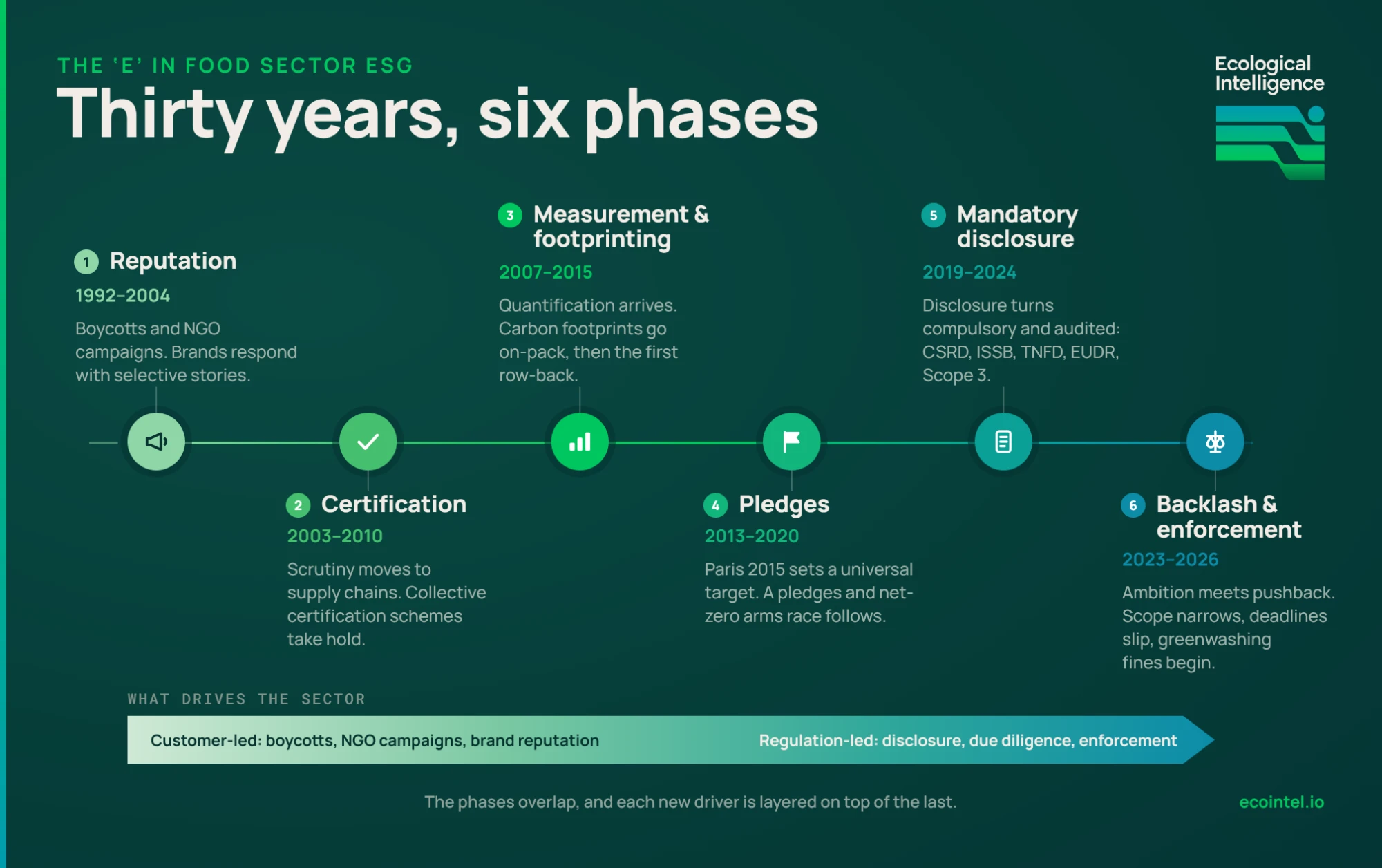
The bookends are a transition from the 1990s when companies were responding to a customer-led agenda of boycotts and NGO campaigns to regulation as the driving force today. The key aspects of each phase can be summarised in two dimensions:
- the regulatory and policy perspective
- actions taken by companies.
The analysis is not intended to be exhaustive, but rather to provide a flavour of the essential nature of each phase and some examples. Keen observers will also note that the phases overlap as the reality is of evolving transitions, rather than clean breaks.
1. The Reputation Phase (1992-2004)
Environmental regulation was largely absent for food. Pressure was exception-based and, for most companies, about avoiding scandal. NGOs and consumer boycotts set the agenda while a few corporate pioneers built their own schemes. The first global voluntary frameworks began to take shape.
Regulation and policy
- 1992 The Rio Earth Summit and Agenda 21 set the sustainability frame.
- 1997 The Kyoto Protocol was the first binding emissions treaty, however its binding targets covered only the emissions of industrialised nations.
- 2001 The GHG Protocol Corporate Standard (WRI/WBCSD) introduced the accounting language that would shape future phases.
Companies and consumers
- 1997 Unilever and WWF founded the Marine Stewardship Council.
- 1997 The Global Reporting Initiative (GRI) created the first common framework for sustainability reporting.
- 1998 Unilever launched its Sustainable Agriculture Initiative.
- 2000 The UN Global Compact was launched by UN Secretary General Kofi Annan and was the first global initiative asking companies to self-commit to environmental, human-rights, labour and anti-corruption principles. Unilever was an early food signatory; Nestlé and Danone soon followed.
- 2000 The Carbon Disclosure Project (CDP) was founded, giving investors a standard channel through which to demand corporate environmental data.
- 2002 The SAI Platform was set up by Nestlé, Unilever and Danone as the food industry’s own pre-competitive sustainable-agriculture coalition.
- The Nestlé infant-formula boycott legacy was a template for citizens using the marketplace as a space for protest.
2. The Certification Phase (2003-2010)
Campaigners shifted from products to supply chains (palm, soy, cocoa, beef) and this led to companies adopting collective certification schemes. Retailers became the enforcers, pushing requirements down onto suppliers.
Regulation and policy
- 2006 The UK Companies Act introduced narrative (non-financial) reporting.
- 2008 The UK Climate Change Act introduced the first legally binding national carbon budgets.
- There was, however, still no food-specific focus.
Companies and consumers
- 2004 The Roundtable on Sustainable Palm Oil (RSPO) was founded (Unilever, Migros, WWF) and the Round Table on Responsible Soy followed in 2006.
- 2006 The Walmart Packaging Scorecard, then Walmart’s Sustainability Index (2009), became the decade’s biggest levers of change.
- 2007 Marks & Spencer launched Plan A (“because when it comes to saving the planet there is no Plan B.”) and Tesco pledged carbon labels on 70,000 products.
- 2007 The UN Global Compact launched Caring for Climate, mobilising CEOs on emissions and energy.
- 2010 Greenpeace’s campaign against Nestlé over deforestation (KitKat and the Orangutan) saw social media become a live corporate risk for the first time and resulted within weeks in the company making a sustainable palm oil pledge.
3. The Measurement and Footprinting Phase (2007-2015)
Quantification became the name of the game. Carbon footprinting arrived on-pack and the first corporate row-back occurred in response to the perception that customers did not reward disclosure. The first mandatory disclosure requirements appeared in EU law.
Regulation and policy
- 2008 PAS 2050 (created by the British Standards Institute and the Carbon Trust) was established as the first product carbon-footprint method.
- 2014 The promulgation of the EU Non-Financial Reporting Directive saw the first EU-wide mandatory non-financial disclosure requirement on companies. The implementation date for first reports was set for 2018. While the framework was not overly demanding, it set the ball rolling on more comprehensive Environment, Social and Governance (ESG) compliance.
Companies and consumers
- 2007-2008 The Carbon Trust launched the world’s first Carbon Reduction Label with early adopters including Walkers Crisps, Kingsmill Bread, Quaker Oats and British Sugar. One of the biggest supporters of the scheme was supermarket chain Tesco.
- 2010 The Unilever Sustainable Living Plan championed by CEO Paul Polman reframed sustainability as strategy, not PR.
- 2010 At the Consumer Goods Forum Global Summit, 400+ firms pledged net-zero deforestation by 2020. The target was not achieved and over time, the work evolved into more nuanced supply chain evolution.
- 2012 Tesco dropped carbon labels on the basis they were too costly and complex to implement, unrewarded by customers and not adopted by other retailers. This was a preview of today’s “greenhushing” (see below).
4. The Pledges Phase (2013-2020)
The 2015 COP meeting in Paris changed everything as every company now had a “universal” target with which to align. This triggered something of a pledges arms race for companies, beginning with net zero, then adding science-based targets and more recently, regenerative acres. Climate became an investor-disclosure issue, bringing the topic firmly into the orbit of the Finance Director.
Regulation and policy
- 2015 The UN Sustainable Development Goals (SDGs) were formally adopted with 17 global goals covering a broad range of social, economic, and environmental issues.
- 2015 The Paris Agreement set a goal of limiting global warming to below 2°C above pre-industrial levels, while pursuing efforts to cap the increase at 1.5°C.
- 2015 The Task Force on Climate-related Financial Disclosures (TCFD) was established (making its first recommendations in 2017) and climate impact became a formal financial-disclosure issue.
- 2019 The EU Green Deal signalled that food-system impact would be regulated, not just reported. Its Farm to Fork strategy followed in 2020.
Companies and consumers
- 2014 The We Mean Business coalition was founded, and RE100 (100% renewable electricity) launched, with Mars, Nestlé and Danone among early joiners of both.
- 2015 The Science Based Targets initiative (SBTi) was established in 2015 as a collaborative partnership to help businesses align their greenhouse gas emission reduction goals with climate science. High-profile food and beverage companies Kellogg’s, General Mills and Coca-Cola launched validated GHG reduction targets.
- 2015 The SDG Compass (UN Global Compact, Global Reporting Initiative and World Business Council for Sustainable Development) gave companies a method to align strategy and reporting to the SDGs.
- 2016 Champions 12.3, launched at the World Economic Forum in Davos and co-chaired by Tesco’s chief executive, called for a halving of food loss and food waste by 2030.
- 2018 The Ellen MacArthur Foundation launched the New Plastics Economy Global Commitment with Nestlé, PepsiCo, Unilever and Mars signed up to address packaging.
- 2019 Danone reported a carbon-adjusted Earnings Per Share as a climate metric in its headline financials and went on to complete B Corp certification in 2025.
- 2019 General Mills committed to support the transition of 1 million acres to regenerative agriculture.
- 2019 The EAT-Lancet Commission answered the question of how to feed 10bn people healthily within planetary boundaries.
- 2019 One Planet Business for Biodiversity (OP2B) was launched at the UN, putting agricultural biodiversity on the CEO agenda.
5. The Mandatory Disclosure and Anti-greenwashing Phase (2019-2024)
Disclosure started to become compulsory, audited and, in theory at least, litigable. Scope 3, the 80 to 95% of a food company’s carbon footprint that sits in the supply chain (most of it on farms), moved to centre stage. Legislation to outlaw loose green claims emerged, but with little enforcement.
Regulation and policy
- 2021 UK made TCFD-aligned disclosure mandatory for large firms.
- 2021 The Task Force on Nature-related Financial Disclosures (TNFD) was founded as a sister framework to the TCFD to address the gaps in nature and biodiversity reporting and released its final, official recommendations for companies to use two years later.
- 2023 The EU Corporate Sustainability Reporting Directive (CSRD) entered into force, marking a transformative evolution in corporate accountability by replacing the 2014 Non-Financial Reporting Directive (NFRD). While the NFRD laid the groundwork for ESG reporting, its flexible guidelines often resulted in inconsistent, non-comparable, and difficult-to-verify disclosures from a limited pool of large companies. The CSRD significantly expanded the number of in-scope entities, standardising disclosures under more rigorous European Sustainability Reporting Standards (ESRS), and mandating the principle of double materiality. By shifting sustainability reporting from a voluntary, high-level exercise under the NFRD to a strictly audited, digitally tagged requirement, the CSRD aimed to elevate environmental and social disclosure to the same standards of rigour as traditional financial reporting. Scope 3 emissions disclosure was mandated for reports from FY2024.
- 2023 The European Union Deforestation Regulation (EUDR) entered into force, though its due-diligence obligations were only to apply later (see phase 6). It was a landmark law designed to ensure that the products EU citizens consume or export do not contribute to global deforestation or forest degradation. It required geolocated, deforestation-free proof for cattle, cocoa, coffee, oil palm, rubber, soya and wood.
- 2023 The International Sustainability Standards Board (ISSB) issued its first two formalised standards designed to replace fragmented legacy frameworks and give capital markets clear, comparable sustainability data. While IFRS S1 sets the foundational rules for general sustainability reporting, IFRS S2 dictates highly specific, climate-focused data disclosures. ISSB had been established by the IFRS Foundation in 2021 to create a truly global, unified baseline for sustainability disclosures. It has absorbed the TCFD and is building on the TNFD recommendations for nature reporting.
- 2023 The EU Green Claims Directive was proposed to combat greenwashing by forcing companies to scientifically back up their environmental marketing. It was subsequently withdrawn due to political pushback regarding the cost and administrative burden it would have placed on the EU’s 30 million micro-enterprises and small businesses.
- 2023 California signed SB 253 and SB 261 into law, requiring large public and private companies doing business in the state to report their greenhouse gas emissions and climate-related financial risks.
- 2024 The EU’s ECGT/EmpCo Directive (Empowering Consumers for the Green Transition) was established to ban several misleading practices outright, including generic eco claims, fake carbon neutrality and self-created corporate eco-badges. Across the Atlantic, the US SEC climate-related disclosure rules were adopted and then promptly rescinded in the face of federal political opposition.
- 2024 The EU Corporate Sustainability Due Diligence Directive (CSDDD) was adopted, turning environmental due diligence from a disclosure exercise into a duty to identify, prevent, mitigate and remediate adverse impacts across the value chain, including harmful soil change, land degradation and deforestation.
Companies and consumers
- 2021 PepsiCo pep+ plan announced to spread “regenerative” agriculture across 7M acres by 2030.
- 2021 By COP26, Business for Nature (launched in 2019) and the UN Race to Zero (2020) were pushing nature and net zero into the mainstream and there were widespread corporate commitments.
- 2021 A big year for food brands and retailers launching/updating detailed net-zero transition plans.
- 2022 SBTi FLAG was launched as the first standard for land-based (farm and forest) emissions targets (mandatory from 2023).
- 2023 The UN Global Compact launched Forward Faster, asking companies to accelerate on climate, water resilience and living wage by 2030.
- Quorn put a carbon footprint on-pack (a 2020 world-first for a meat-free brand) and Arla started running farm-level climate checks. Consumer interest in nature disclosure, however, seemed to lower with the cost-of-living squeeze being blamed.
6. The Backlash, Simplification and Enforcement Phase (2023-2026)
The pendulum swung as regulatory ambition met political and cost pushback. As a result, enforcement deadlines slipped and scope narrowed. By contrast, enforcement of existing claims law has hardened, and substantiation of claims has become the central challenge.
Regulation and policy
- 2025 The EU Omnibus “stop the clock” delayed CSRD reporting for companies due to report in “waves 2 and 3” by two years.
- 2026 A separate Omnibus directive (adopted February 2026) cut CSRD’s mandatory reporting scope to companies with more than 1,000 staff and over €450m net turnover. It sharply reduced the number of firms in scope but leaves many large companies with the problem that much of their supply chain is smaller firms whose disclosure is now voluntary. This means the data many large companies need does not exist.
- 2026 The Omnibus also narrowed the CSDDD to companies above 5,000 staff and over €1.5bn turnover (about 2,900 firms) and deleted its Article 22 climate-transition-plan duty, though the underlying obligation persists through the CSRD, sector rules and national courts.
- 2026 The ECGT/EmpCo Directive banning greenwashing is in force, effective from 27 September, and empowers Member State consumer authorities to levy fines reaching up to 4% of a company’s annual turnover in the violating Member States.
Companies and consumers
- US anti-ESG politics has had a chilling effect on disclosure.
- Greenhushing has spread, with large food brands still doing the work “under the radar” but generally saying less, both to avoid political targeting and potential litigation.
What can and should Food Sector Companies do now?
The central issues for food sector companies to solve now are the twin problems of field level data and management systems that enable them to assess and manage Ecosystem Condition across farms involved in their supply chain.
The analysis in the previous section explored how over the past 30 years, the requirements of the “E” in ESG have evolved. The focus has shifted from cherry picking, via expanding scope towards ever more comprehensive proof of what is happening to nature overall and to the demand for active management to improve outcomes. Since most food companies are dependent on farmed land, this creates the requirement to understand and manage for the ecosystem condition of that land.
The focal nexus of action that will force company boards to invest time and attention in this arena is the various disclosure frameworks. The two major drivers are TNFD and CSRD (see above). TNFD asks companies to assess the state of nature. CSRD’s ESRS E4 requires disclosure on the condition of the ecosystems which a business affects and on which it is dependent. While the language may vary, a common feature is that these assessments cannot be done from secondary information like carbon and biodiversity scores. Whether a food company can comply, will depend on how it solves the problem of access to farm-level ecosystem condition assessment and how good that assessment is in terms of its ability to guide management decisions.
In looking at what’s available in the data systems market, we found more than 50 field-data tools in use in the food sector.
Almost all measure a single attribute or a group of attributes. However, the challenge is that carbon, species counts, or land cover individually or even collectively provide only a limited view of the functioning whole.
In addition, such systems also find it difficult, if not impossible to meet the objective of giving a food sector company the ability to manage for better outcomes. Knowing how much carbon is sequestered does not guide what to do next to improve the figure. And even evidence of what has worked elsewhere is a poor guide for decision making.
In the investment world, one standard disclaimer is “the past is not a guide to the future”. In land management the disclaimer should be “what works there often won’t work here.” It is something most farmers know all too well and often have learnt from the painful experience of failure.
The problem of leading versus lagging indicators
One core problem in assessing land health has been that most of what is measured falls into the category of Lagging Indicators. Such indicators are snapshots after the fact. Examples include carbon sequestration levels, biodiversity counts and even soil quality.
Their power is in describing with accuracy (as far as sampling allows), the outcomes of what has happened in nature.
Lagging indicators, however, have little to say on their own, about what is unfolding right now and what will happen in the future. They cannot answer questions like “Is the way nature is functioning here going to lead to a further improvement or a decline? How resilient are things? Is this result due to good weather or good management?”
By contrast, leading indicators assess the current health of a system and enable diagnosis of why it is performing the way it is.
The most important leading indicators are the four ecosystem processes on which all life depends. They are the water cycle, the energy cycle, the mineral cycle and the relationships between living things (the last of these four being formally termed ecological community dynamics).
Analysing leading indicators is about understanding flows. Flows are a central concept in understanding systems. It is fundamentally a shift in thinking patterns from a focus on “the things” to a focus on “the relationships unfolding between the things”. A simple example is not how much rainfall happens, but how well that water is utilised to create life.
Being equipped with an analysis built on leading indicators creates the possibility of understanding why the system is functioning the way it is. This in turn opens the door to making better management decisions and therefore improving the results achieved.
Traditionally this assessment of why and what to do next has been the domain of field ecologists and agronomic experts. They can be extremely effective. However, when looking at ecosystem condition and primary indicators, the process is expensive. What is needed is a system which can understand leading indicators and therefore ecosystem condition at scale and affordably.
From in-field analysis to remote sensing
Remote sensing systems (primarily satellite observation) can provide vast amounts of data at much lower cost than in-field assessment. However, the power of a system is only as good as the way it then translates what is available into useful and usable information. Solving this problem has been our work at Ecological Intelligence, set out in full in our technical paper, the EcoDynamics Diagnostic Engine.
An obvious question is how a system that observes the land from above can speak to the functional health of soil and water. The answer lies in the science of landscape function. Decades of field ecology show that what happens below ground reveals itself at the surface. Vegetation vigour, ground cover, canopy moisture and the pattern of growth through the seasons are all closely correlated with the soil properties and cycles that drive them. In the validation of our system, its results agree well with expert field assessments.
EcoIntel, the system we have built, analyses such signals to separate, for example, the roles of place, weather and management. It can distinguish poor ecosystem condition caused by an inherently difficult landscape or a poor season from one caused by how the land is being farmed. The ability to make that diagnosis is what turns observations into meaningful actionable information. It enables a context-specific diagnosis rather than relying on a generic model applied from one place to another.
From a compliance perspective, such an assessment and diagnosis process can become management-grade, independent evidence, produced without relying on self-reported farm data. It provides a field-level capability to guide action on the ground.
This does not replace, for example, audited carbon accounts a company files for statutory reporting. What it does do is both enable a much wider understanding of the health of nature and provide the tools to manage for better outcomes.
It is this kind of capability that provides the lever for the food sector to transition from being one of our most destructive ecological problems, to being a key contributor to solving them. It is an opportunity to be grasped with both hands.
Afterthought: Closing the loop of the 30-year journey from consumer pressure to regulation and back again
When food companies first embarked on sharing their ecological impact 30 years ago, it was generally a brand story responding to demands from customers. Now it is regulation that sets the pace.
Today and in the future, by focussing on managing for improvements in ecosystem condition, companies will increasingly be able to meet the demands of the regulatory reality that is now dominating the agenda AND return to the roots of this whole movement, the needs and interest of customers.
This is because ecosystem condition is what, in the end, people really care about. It answers the most simple question behind the very origins of having the “E” of ESG:
Are we doing a better job of stewarding nature or not and what should we do next?
Frequently asked
What is ecosystem condition, and why does it matter for food companies?
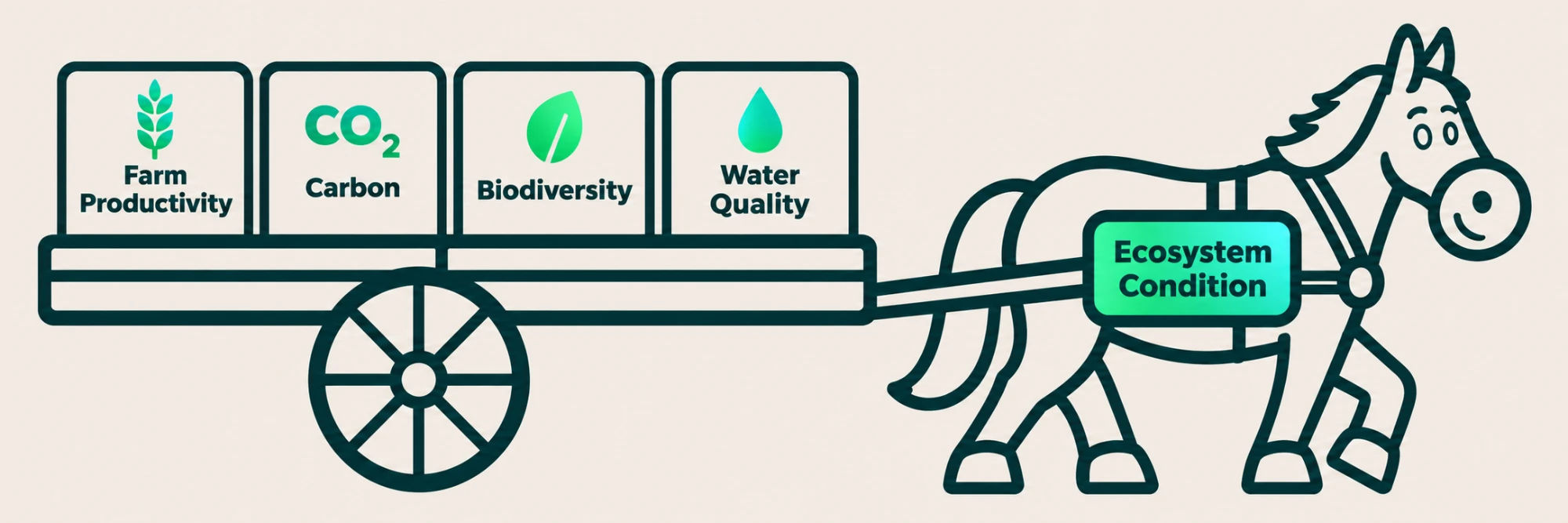
Ecosystem condition is a measure of how healthy and well-functioning nature is overall, rather than a single metric such as carbon. It is the driving force behind outcomes like farm productivity, carbon, biodiversity and water quality. Disclosure frameworks now ask food companies to assess and manage it across the farms in their supply chains.
Why is carbon or net zero no longer enough for food-sector environmental reporting?
Carbon, species counts or land cover each capture only part of a functioning whole. Over 30 years the requirement has shifted from single metrics towards complete, credible evidence of what is happening to nature, and towards a duty to improve it. Partial claims now carry greenwashing and compliance risk.
What is the difference between leading and lagging indicators of land health?
Lagging indicators, such as carbon sequestered, biodiversity counts and soil quality, are snapshots after the fact. Leading indicators assess the current health of a system and why it is performing as it is. The most important are the four ecosystem processes: the water cycle, the energy cycle, the mineral cycle and the relationships between living things.
What do TNFD and CSRD's ESRS E4 require food companies to report?
TNFD asks companies to assess the state of nature. ESRS E4, under the CSRD, requires disclosure on the condition of the ecosystems a business affects and depends on. Neither can be satisfied from secondary data like carbon or biodiversity scores alone, so companies need field-level ecosystem condition assessment across their farms.
How much of a food company's environmental footprint sits in its supply chain?
Typically 80 to 95%, with the great majority on farms. This is the hardest part to measure and manage, both practically and cost effectively, and it is why field-level, management-grade evidence of ecosystem condition has become the central problem to solve.
References
Regulation, policy and law
- Rio Earth Summit and Agenda 21 (1992), UN. https://www.un.org/en/conferences/environment/rio1992
- Kyoto Protocol (1997), UNFCCC. https://unfccc.int/kyoto_protocol
- UK Companies Act 2006, s.417 narrative reporting. https://www.legislation.gov.uk/ukpga/2006/46/section/417
- UK Climate Change Act 2008, carbon budgeting. https://www.legislation.gov.uk/ukpga/2008/27/part/1/crossheading/carbon-budgeting
- Paris Agreement (2015), UNFCCC. https://unfccc.int/process-and-meetings/the-paris-agreement
- UN Sustainable Development Goals (2015). https://sdgs.un.org/goals
- EU Non-Financial Reporting Directive, 2014/95/EU. https://eur-lex.europa.eu/eli/dir/2014/95/oj
- EU Green Deal (2019), European Commission. https://commission.europa.eu/strategy-and-policy/priorities-2019-2024/european-green-deal_en
- EU Farm to Fork Strategy (published May 2020), European Commission. https://food.ec.europa.eu/horizontal-topics/farm-fork-strategy_en
- UK mandatory TCFD-aligned disclosure (2021, extended 2022). https://www.akingump.com/en/insights/alerts/uk-extends-mandatory-tcfd-climate-disclosures-beyond-premium-listed-companies-to-all-large-companies-and-llps
- EU Corporate Sustainability Reporting Directive (CSRD), 2022/2464. https://eur-lex.europa.eu/eli/dir/2022/2464/oj
- EU ESRS delegated regulation, 2023/2772 (includes ESRS E4 Biodiversity and Ecosystems). https://eur-lex.europa.eu/eli/reg_del/2023/2772/oj
- EU Deforestation Regulation (EUDR), 2023/1115. https://eur-lex.europa.eu/eli/reg/2023/1115/oj
- EUDR explainer and the seven commodities, World Resources Institute. https://www.wri.org/insights/explain-eu-deforestation-regulation
- EUDR postponement to 30 December 2026 (Council, 18 December 2025). https://www.consilium.europa.eu/en/press/press-releases/2025/12/18/deforestation-council-signs-off-targeted-revision-to-simplify-and-postpone-the-regulation/
- EU Empowering Consumers Directive (EmpCo), 2024/825. https://eur-lex.europa.eu/eli/dir/2024/825/oj
- EmpCo application date (27 September 2026), European Commission. https://commission.europa.eu/topics/consumers/consumer-rights-and-complaints/sustainable-consumption_en
- EU Green Claims Directive, proposed 22 March 2023, European Commission. https://environment.ec.europa.eu/topics/circular-economy/green-claims_en
- EU Green Claims Directive, intention to withdraw (June 2025), Latham & Watkins. https://www.lw.com/en/insights/european-commission-announces-intention-to-withdraw-eu-green-claims-directive-proposal
- EU Omnibus “stop the clock” Directive, 2025/794 (dates only). https://eur-lex.europa.eu/eli/dir/2025/794/oj
- EU Omnibus substantive scope change (Council sign-off, 24 February 2026). https://www.consilium.europa.eu/en/press/press-releases/2026/02/24/council-signs-off-simplification-of-sustainability-reporting-and-due-diligence-requirements-to-boost-eu-competitiveness/
- Omnibus explained (CSRD and CSDDD changes), Accountancy Europe. https://accountancyeurope.eu/publications/omnibus-explained-key-changes-to-the-csrd-and-csddd/
- California SB 253 and SB 261 (signed October 2023), Watershed guide. https://watershed.com/blog/california-disclosures-a-guide-for-companies
- California SB 261 partial stay on appeal (2025-26 update), Nixon Peabody. https://www.nixonpeabody.com/insights/alerts/2026/03/02/california-climate-disclosure-laws-update
- US SEC climate-disclosure rule, adopted March 2024, then stayed. https://www.sec.gov/news/press-release/2024-31
- EU Corporate Sustainability Due Diligence Directive (CSDDD), 2024/1760, as amended by Omnibus I. https://eur-lex.europa.eu/eli/dir/2024/1760/oj
- ClientEarth and Frank Bold, Corporate Environmental and Climate Due Diligence and Reporting in the EU, September 2026. https://www.clientearth.org
Frameworks, standards and methods
- GHG Protocol Corporate Standard, WRI/WBCSD (2001). https://ghgprotocol.org/corporate-standard
- PAS 2050, first product carbon-footprint method, BSI/Carbon Trust/Defra (2008). https://ghgprotocol.org/sites/default/files/2022-12/GHG%20Protocol%20PAS%202050%20Factsheet.pdf
- Global Reporting Initiative (GRI), founded 1997. https://www.globalreporting.org/about-gri/who-we-are/
- Task Force on Climate-related Financial Disclosures (TCFD), established 2015. https://www.fsb-tcfd.org/about/
- TCFD recommendations (2017), FSB. https://www.fsb.org/2017/06/recommendations-of-the-task-force-on-climate-related-financial-disclosures-2/
- ISSB IFRS S1 and S2, global baseline (issued June 2023), IFRS Foundation. https://www.ifrs.org/news-and-events/news/2023/06/issb-issues-ifrs-s1-ifrs-s2/
- Taskforce on Nature-related Financial Disclosures (TNFD), state-of-nature measurement. https://tnfd.global/publication/discussion-paper-on-state-of-nature-measurement/
- Science Based Targets initiative (SBTi), launched 2015. https://sciencebasedtargets.org/about-us
- SBTi FLAG guidance (launched September 2022, targets required from May 2023). https://sciencebasedtargets.org/sectors/forest-land-and-agriculture
- UN SEEA Ecosystem Accounting, ecosystem condition (composition, structure, function). https://seea.un.org/ecosystem-accounting
Initiatives, coalitions and certification schemes
- Marine Stewardship Council (MSC), founded 1997. https://www.msc.org/about-the-msc/our-history
- UN Global Compact, launched 2000. https://unglobalcompact.org/what-is-gc
- UN Global Compact, Caring for Climate (2007). https://unglobalcompact.org/take-action/action/climate
- UN Global Compact, Forward Faster (2023). https://www.globenewswire.com/news-release/2023/09/18/2744401/0/en/Forward-Faster-Initiative-to-accelerate-private-sector-action-to-reach-SDGs.html
- CDP (formerly Carbon Disclosure Project), founded 2000. https://www.cdp.net/en
- SAI Platform, founded 2002. https://saiplatform.org/who-we-are/our-story/
- Roundtable on Sustainable Palm Oil (RSPO), founded 2004. https://rspo.org/about
- Round Table on Responsible Soy (RTRS), founded 2006. https://responsiblesoy.org/about-rtrs?lang=en
- Consumer Goods Forum, net-zero deforestation resolution (2010). https://www.theconsumergoodsforum.com/implementing-and-scaling-up-the-cgf-zero-net-deforestation-commitment/
- We Mean Business and RE100 (2014). https://there100.org/re100
- SDG Compass (2015), UN Global Compact, GRI, WBCSD. https://unglobalcompact.org/news/2551-09-26-2015
- Champions 12.3, halving food loss and waste (2016), UNEP. https://www.unep.org/news-and-stories/press-release/new-champions-123-coalition-inspires-action-halve-global-food-waste
- Ellen MacArthur Foundation, New Plastics Economy Global Commitment (2018). https://www.ellenmacarthurfoundation.org/press-release-businesses-back-2030-agenda-to-drive-change-in-plastics-system
- One Planet Business for Biodiversity (OP2B), launched 2019, WBCSD. https://www.wbcsd.org/news/nineteen-leading-companies-join-forces-to-step-up-alternative-farming-practices-and-protect-biodiversity-for-the-benefit-of-planet-and-people/
- Business for Nature, launched 2019. https://www.businessfornature.org/who-we-are/our-story
- UN Race to Zero, launched 2020, UNFCCC. https://climateaction.unfccc.int/Initiatives?id=Race_to_Zero
Corporate milestones
- Nestlé infant-formula boycott (from 1977). https://en.wikipedia.org/wiki/Nestl%C3%A9_boycott
- Unilever Sustainable Agriculture programme (1998). https://www.unilever.com/sustainability/growing-a-sustainable-future/
- Walmart Packaging Scorecard (2006) and Sustainability Index (2009), Trellis. https://trellis.net/article/game-why-walmart-ranking-suppliers-sustainability/
- M&S Plan A (2007), Marks & Spencer. https://corporate.marksandspencer.com/sustainability
- Tesco carbon-label pledge (2007) and withdrawal (2012), Environment+Energy Leader. https://www.environmentenergyleader.com/stories/tesco-quits-carbon-labeling,19650
- Walkers, first Carbon Trust carbon-reduction label (2007), Morning Advertiser. https://www.morningadvertiser.co.uk/Article/2007/03/16/Walkers-to-spearhead-carbon-footprint-labelling/
- Greenpeace v Nestlé, KitKat and orangutan (2010), CNN. https://edition.cnn.com/2010/WORLD/asiapcf/03/19/indonesia.rainforests.orangutan.nestle/index.html
- Unilever Sustainable Living Plan, Paul Polman (2010). https://www.unilever.com/sustainability/
- Danone carbon-adjusted EPS, FY2019. https://www.globenewswire.com/news-release/2020/02/26/1990629/0/en/DANONE-Strong-progress-on-profitable-growth-in-2019-2020-investment-to-accelerate-climate-action-of-our-brands-and-strengthen-our-growth-model.html
- Danone global B Corp certification (November 2025). https://www.danone.com/newsroom/press-releases/b-corp-full-certification.html
- General Mills, 1 million regenerative acres (2019). https://www.prnewswire.com/news-releases/general-mills-to-advance-regenerative-agriculture-practices-on-one-million-acres-of-farmland-by-2030-300805224.html
- EAT-Lancet Commission (2019). https://eatforum.org/knowledge/diets-for-a-better-future/2019-eat-lancet-commission/
- Beyond Meat IPO (May 2019), CNBC. https://www.cnbc.com/2019/05/02/beyond-meat-ipo.html
- Oatly IPO (May 2021), CNBC. https://www.cnbc.com/2021/05/20/oatly-ipo-otly-starts-trading-on-nasdaq.html
- PepsiCo pep+, regenerative agriculture across 7 million acres (2021). https://www.pepsico.com/newsroom/press-releases/2021/pepsico-announces-2030-goal-to-scale-regenerative-farming-practices-across-7-million-acres
- Quorn on-pack carbon labels (2020), FoodNavigator. https://www.foodnavigator.com/Article/2020/01/13/Quorn-s-carbon-labels-The-sustainability-crisis-needs-a-space-in-the-spotlight/
- Arla Climate Check, externally verified farm-level emissions data (from 2020), Arla. https://www.arla.com/sustainability/the-farms/how-we-measure-dairy-farmings-carbon-footprint/
The market map: assessment tools referenced
- Board (carbon accounting and ESG disclosure): Watershed (https://watershed.com), Persefoni (https://persefoni.com), Sweep (https://www.sweep.net), Normative (https://normative.io), Microsoft Sustainability Manager (https://www.microsoft.com/sustainability), Salesforce Net Zero Cloud (https://www.salesforce.com/net-zero/cloud/).
- Product (agri-food Scope 3 and MRV carbon): Cool Farm Tool (https://coolfarmtool.org), Regrow (https://www.regrow.ag), HowGood (https://howgood.com), CarbonCloud (https://carboncloud.com), Trinity AgTech / Sandy (https://www.trinityagtech.com), Agreena (https://agreena.com), Soil Capital (https://soilcapital.com).
- Landscape (satellite, remote sensing and EUDR traceability): Satelligence (https://satelligence.com), Planet (https://www.planet.com), Space Intelligence (https://www.space-intelligence.com), Sourcemap (https://www.sourcemap.com), Meridia (https://www.meridia.land).
- Label (certification and eco-labels): Fairtrade (https://www.fairtrade.net), Rainforest Alliance (https://www.rainforest-alliance.org), RSPO (https://rspo.org), LEAF Marque (https://leaf.eco), Regenerative Organic Certified (https://regenorganic.org).
- The Field (understanding ecosystem condition): NatureMetrics (https://www.naturemetrics.com), Pivotal (https://www.pivotal.earth), EcoIntel (https://ecointel.io).
- Mapping and planning (not an assessment tool): Land App (https://thelandapp.com).
Scientific and evidence sources
- Food-sector Scope 3 is 90%+ of a food company’s emissions, WWF. https://www.worldwildlife.org/news/perspectives/sustainability-works-hub/sustainability-works-index/engaging-in-the-food-supply-chain-scope-1-2-and-3-emissions-in-greenhouse-gas-accounting/
- Agriculture is 70%+ of food-related emissions, WWF Markets Institute. https://www.worldwildlife.org/news/press-releases/wwf-report-how-food-companies-are-incentivizing-reduction-of-supply-chain-greenhouse-gas-emissions/
- Poore and Nemecek (2018), the farm stage dominates food’s footprint, Science. https://www.science.org/doi/10.1126/science.aaq0216
- Smith (2004), how long before a change in soil organic carbon can be detected, Global Change Biology. https://onlinelibrary.wiley.com/doi/10.1111/j.1365-2486.2004.00854.x
- Soil-organic-carbon MRV review (2026), at least five years to detect change, Carbon Management. https://www.tandfonline.com/doi/full/10.1080/17583004.2026.2638317
- eDNA in agricultural systems: uses and limitations, ScienceDirect. https://www.sciencedirect.com/science/article/pii/S004896972204654X
- eDNA limitations acknowledged (primers, reference-database gaps, decay), NatureMetrics FAQ. https://www.naturemetrics.com/faqs
- Ecosystem condition accounting (composition, structure, function), One Ecosystem / UN SEEA. https://oneecosystem.pensoft.net/article/58216/
EcoIntel
- EcoIntel, The EcoDynamics Diagnostic Engine (EDDE), v1.0, 2026. https://ecointel.io/science/the-ecodynamics-diagnostic-engine-edde/
- EDDE, Zenodo record, DOI 10.5281/zenodo.22082626 (CC BY 4.0). https://doi.org/10.5281/zenodo.22082626