
Land Health Credential
Planton Court Farm
A regenerative mixed farm in the Shropshire hills
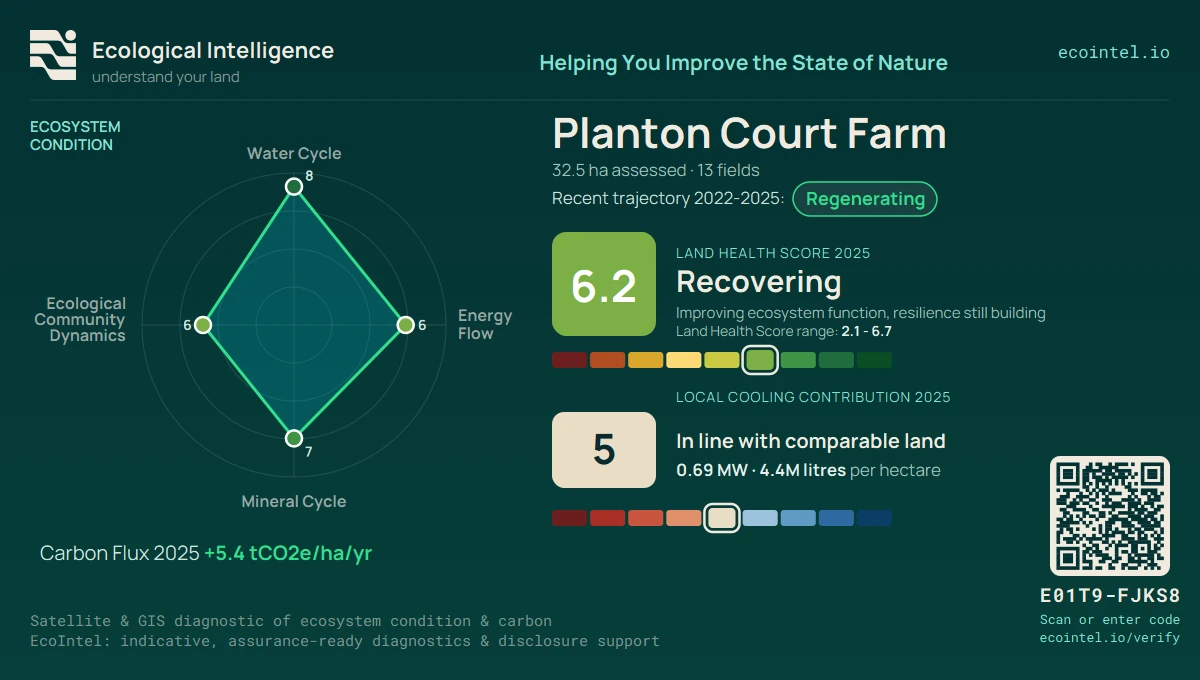
Confirmed genuine in the EcoIntel register · code E01T9-FJKS8
Issued 8 September 2026, valid until 8 September 2027.
You are viewing the 2025 assessment. The current assessment is 2026 · 5.1 Transitional.
- Where
- Coreley, near Ludlow, Shropshire
- Size
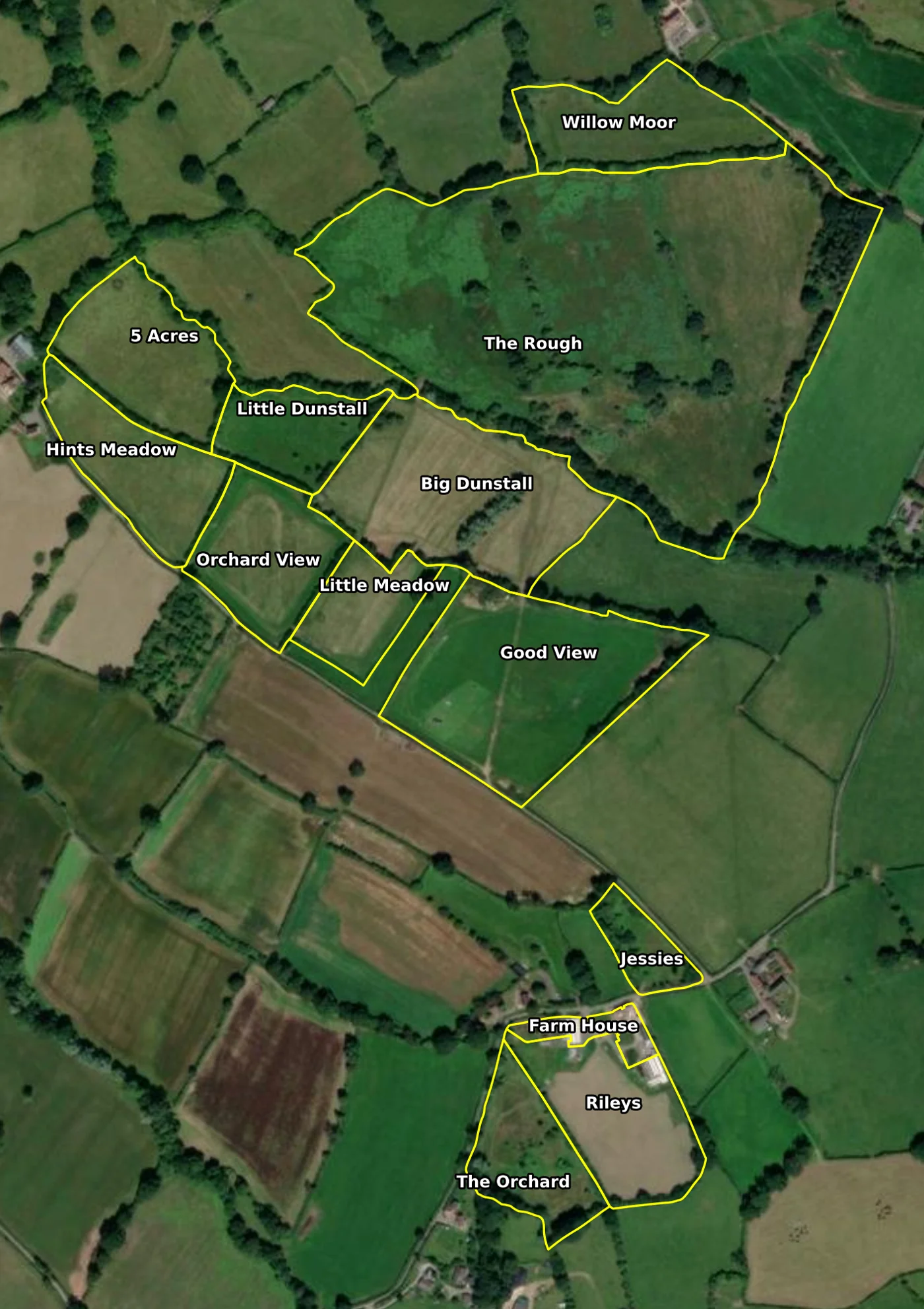
- 32.5 ha, 13 fields
- Land
- Permanent grassland, wood pasture and orchard
- Land Health Score
- 6.2 RecoveringTrajectory: Regenerating
- Net carbon
- +5.4 tCO2e/ha/yr
Clare Hill came to farming from the other end of the food system, after more than twenty years working on animal welfare, sustainability and supply chains for some of the largest food businesses in the country. She led a 1,200-acre farm from organic to regenerative production, taking it to the Savory Institute’s Ecological Outcome Verification in 2020, and has advised food and retail businesses on their own regenerative programmes. In 2021 she took Planton Court on as a co-founder and put that experience to work on her own ground.
Planton Court sits in the Shropshire hills, gently rolling and mostly south-facing: permanent grassland, ancient hedgerow oaks, a traditional cider orchard, wood pasture and a young food forest. Clare runs pasture-raised beef under planned grazing, pasture-raised chicken, organic eggs and a market garden. The farm holds Pasture for Life and OF&G Organic status, and four consecutive seasons of the Savory Institute’s EOV have come back as regenerating. It is also a teaching farm: Clare runs workshops, mentoring and tours, and with Caroline Grindrod she runs Roots to Regeneration, a two-year transition programme for other farmers and for the professionals in food, farming and finance who influence land without owning it.
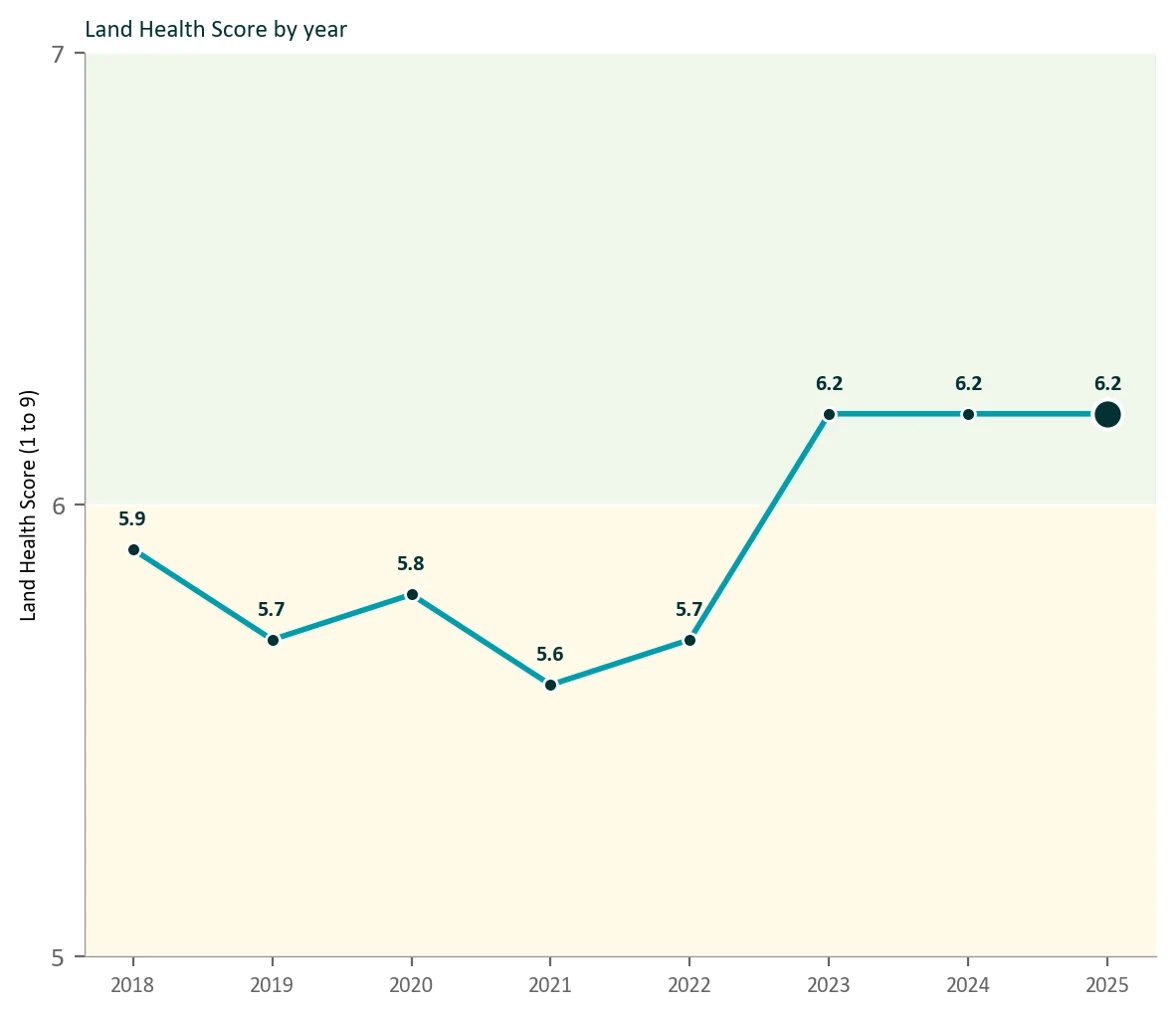
When Clare took the farm on it was scoring Level 5, Transitional. It has since moved into Level 6, and across the eight years to 2025 its trajectory is Regenerating.
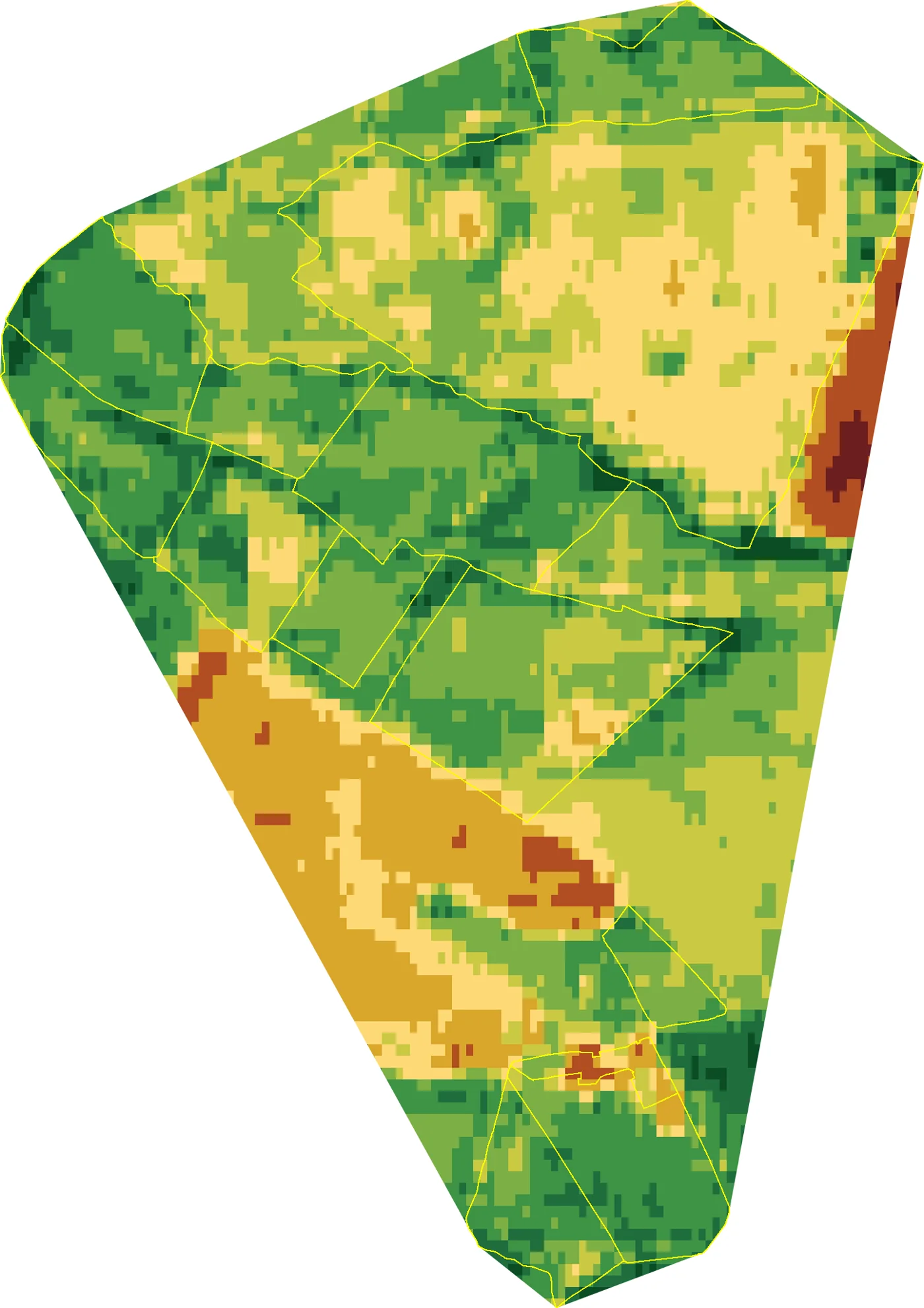
Trajectory: Regenerating
The Land Health Score across the 2018 to 2025 satellite record.
Four ecosystem processes
The water cycle, energy flow, mineral cycle and community dynamics, each on the 1 to 9 Land Health scale. Switch land-use track:
Land health classification
- 9 Flourishing
- 8 Thriving
- 7 Healthy
- 6 Recovering
- 5 Transitional
- 4 Stressed
- 3 Degraded
- 2 Depleted
- 1 Collapsed
Evaporative cooling
Local cooling contribution: 5 in line with comparable land
Against trees, grass and crops 0.5 to 10 km around, matched for elevation and distance to coast, on the same satellite passes.
4.7 to 7.1 (average 6.6)
Steady evaporative cooling
How much absorbed sunlight the land turns into water vapour, not heat. A working water cycle cools; bare or stressed ground heats.
Planton Court Farm moves about 144 million litres of water into the air over the growing season, roughly 70% of it through living plants.
- 144M LWater into the air, per season
- 70%Cooling by living plants, not bare soil
- 19%lowSunlight reflected; the cooling leans on evaporation
- 26 wksWeeks actively green, typical field
Per hectare0.69 MW cooling 4.4M litres water
Assessment is net of albedo (sunlight absorbed by darker, living canopy). The data presented here describes the net cooling effect, i.e. evaporation after albedo.
The EcoIntel Land Health Credential in Machine-readable Format
EcoIntel's Land Health credentials are available as a machine-readable W3C Verifiable Credential and as JSON, independently verifiable against our published key, so an AI-agent can consume and trust them as-is.
- Verifiable Credential 2.0 application/vc+ld+json, eddsa-jcs-2022
- Credential record application/json
- Issuer key did:web:www.ecointel.io
- Verify a credential file in your browser
The EcoIntel Land Health Credential is an independent, satellite- and GIS-evidenced assessment of ecosystem functioning.